Category: Space

  • European Space and Telecoms Players Sign Partnership Agreement to Bid for IRIS2 Constellation

    European Space and Telecoms Players Sign Partnership Agreement to Bid for IRIS2 Constellation

    Copyright: Airbus

    Luxembourg / Madrid / Munich / Paris, 2nd May, 2023. A group of European space and telecommunications players have come together to form a partnership to respond to the European Commission’s call for tender related to the future European satellite constellation IRIS² (Infrastructure for Resilience, Interconnectivity and Security by Satellite). IRIS² aims to bring a new secure and resilient connectivity infrastructure to European governments, businesses and citizens.

    The open consortium will be governed by Airbus Defence and Space, Eutelsat, Hispasat, SES and Thales Alenia Space. The consortium will also rely on the core team of the following companies: Deutsche Telekom, OHB, Orange, Hisdesat, Telespazio, and Thales. Together, they will aim to create a state-of-the-art satellite constellation based on a multi-orbit architecture that would be interoperable with the terrestrial ecosystem.

    This partnership will set up an integrated best-in-class European space and telecoms team across these companies to leverage the expertise and capabilities in the field of secure satellite communications solutions. The consortium will encourage start-ups, mid-Caps and SMEs to join the partnership, resulting in a more innovative and competitive European space sector where new business models will emerge.

    The integrated team aims to foster collaboration among all European space players across the whole connectivity value chain with a view to enabling EU’s strategic autonomy through the delivery of sovereign, secure and resilient government services to protect European citizens. The team will leverage synergies between government and commercial infrastructures. The teaming partners are also well positioned to provide commercial services to bridge the digital divide across European territories and to increase Europe’s global outreach and competitiveness as a space and digital power on the global market.

    IRIS² will deliver resilient and secure connectivity solutions to governments to protect European citizens and will provide commercial services in the interest of European economies and societies. It will also bolster the EU partnership policy by offering its infrastructure abroad. IRIS² is the EU’s new flagship space programme for a digital, resilient and safer Europe.

  • General Atomics Delivers Spacecraft Simulator Supporting NASA TSIS-2 Program

    General Atomics Delivers Spacecraft Simulator Supporting NASA TSIS-2 Program

    SAN DIEGO. On 1st May, 2023, General Atomics Electromagnetic Systems (GA-EMS) announced that it has developed and delivered a spacecraft simulator to the University of Colorado (CU) Laboratory for Atmospheric and Space Physics (LASP) in support of the Total and Spectral solar Irradiance Sensor- 2 (TSIS-2) spacecraft program.  GA-EMS is under contract with NASA’s Goddard Space Flight Center (GSFC) to build the TSIS-2 spacecraft, which will provide measurements of solar irradiance and high-quality data for the long-term climate record. CU LASP is providing the Total Irradiance Monitor (TIM) and Spectral Irradiance Monitor (SIM) sensors for TSIS-2.

    “This represents the first complete end-to-end spacecraft simulator we have designed, programmed, built, and delivered to a customer, adding another significant capability to our space systems and technologies portfolio,” stated Scott Forney, president of GA-EMS. “The spacecraft simulator allows us to check the communication and functionality of the TSIS-2 payload onboard our GA-150 satellite bus in preparation for satellite operations. Although the delivered simulator is specific to TSIS-2, we have an experienced team in-house to develop and build simulators to support new customers and satellite programs.”

    The TSIS-2 spacecraft simulator provides capabilities to send and verify commands, receive health and status telemetry, and receive science and analog thermistor data and specific command file uploads. The spacecraft simulator provides valuable capabilities to test system performance, payload interfaces, and functions pre-flight in preparation for on-orbit mission operations.  GA-EMS has designed and is manufacturing the TSIS-2 satellite based on its modular and scalable GA-150 ESPA-class bus architecture. GA-EMS is also performing TSIS-2 payload integration and testing and will provide mission operations support. Once launched, the satellite will operate in a sun-synchronous orbit, with the TSIS-2 payload providing NASA with continuous solar monitoring capabilities throughout its mission life.

    “We provide an agile approach to satellite design, test, manufacturing, and payload integration to help customers access space and execute their missions,” stated Gregg Burgess, vice president of GA-EMS Space Systems. “Simulation is a critical step in satellite design to help maximize risk mitigation. Not only does this allow us to evaluate spacecraft and component performance under various scenarios prior to launch, it is also a valuable tool for troubleshooting and resolving any issues that might arise while the satellite is on orbit.”

    About General Atomics Electromagnetic Systems
    General Atomics Electromagnetic Systems (GA-EMS) Group is a global leader in the research, design, and manufacture of first-of-a-kind electromagnetic and power generation systems. GA-EMS’ history of research, development, and technology innovation has led to an expanding portfolio of specialized products and integrated system solutions supporting aviation, space systems and satellites, missile defense, power and energy, and processing and monitoring applications for defense, industrial, and commercial customers worldwide.

  • Lockheed Martin’s First LM 400 Multi-Mission Space Vehicle Completes Demanding Testing Milestone

    Lockheed Martin’s First LM 400 Multi-Mission Space Vehicle Completes Demanding Testing Milestone

    Lockheed Martin’s LM 400 satellite was designed by the company in a truly digital environment, on its advanced production line outside of Denver, Colorado.

    DENVER, 19th April,2023. The first Lockheed Martin LM 400, a versatile, mid-sized satellite which can be adapted for military, civil or commercial uses, has successfully completed Electromagnetic Interference/Electromagnetic Compatibility testing. This trial is crucial to ensure that signals from the satellite bus components will not interfere with critical payloads during operations.

    The spacecraft, which finished assembly in December, is also working toward completion of rigorous thermal vacuum (TVAC) testing.

    “This successful testing of LM 400 helps prove the satellite’s design integrity and operational capabilities,” said Malik Musawwir, Lockheed Martin Space’s satellite center of excellence vice president. “This is a significant accomplishment for this new satellite and the space vehicles that will leverage this platform from our advanced digital LM 400 production line.”

    LM 400 Spacecraft: Higher Power, More Mission Flexibility

    The agile LM 400 spacecraft enables one platform to perform multiple missions, including remote sensing, communications, imaging, radar and persistent surveillance. Additionally, the scalable and versatile design provides a new level of flexibility and the necessary power to quickly meet a wide range of customer needs and missions, including accelerating demand for more proliferated systems. The spacecraft also benefits from production capabilities such as augmented and virtual reality and artificial intelligence. With increased commonality, LM 400 reduces schedule and cost while also maintaining quality.

    The multi-mission satellite offers:

    • Versatility that can host a variety of payloads with limited or no changes in low, medium and geosynchronous earth orbits.
    • Broad set of missions with pre-defined trim packages to meet specific mission needs.
    • Joint all-domain operations and joint all-domain command and control with a Modular Open Systems Architecture.
    • Greater mission adaptability and onboard “Edge” data processing with SmartSat™, Lockheed Martin’s software-defined satellite architecture.
    • High-rate production capability to meet large constellation needs.
    • Cost and schedule efficiency enabled by supply chain agreements and automation throughout the product lifecycle, from inventory management to manufacturing and test.

    “The LM 400’s digital design allows for multiple versions to be seamlessly produced – including a ‘flat satellite’ that will support rapid launching of up to six stackable space vehicles at a time,” adds Musawwir. “These types of 21st Century Security agile deterrence capabilities will provide our customers with maximum flexibility for their missions.”

    The LM 400 is already under several contracts, most recently being named as a satellite bus supporting U.S. Space Force’s planned Missile Track Custody program in medium earth orbit.

    When launched, the LM 400 will feature a Lockheed Martin-produced Electronically Steered Array.

  • Northrop Grumman Rapidly Completes Critical Design Review for Tranche 1 Transport Layer

    Northrop Grumman Rapidly Completes Critical Design Review for Tranche 1 Transport Layer

    • 42-satellite constellation will provide resilient, secure communications for U.S. troops operating globally
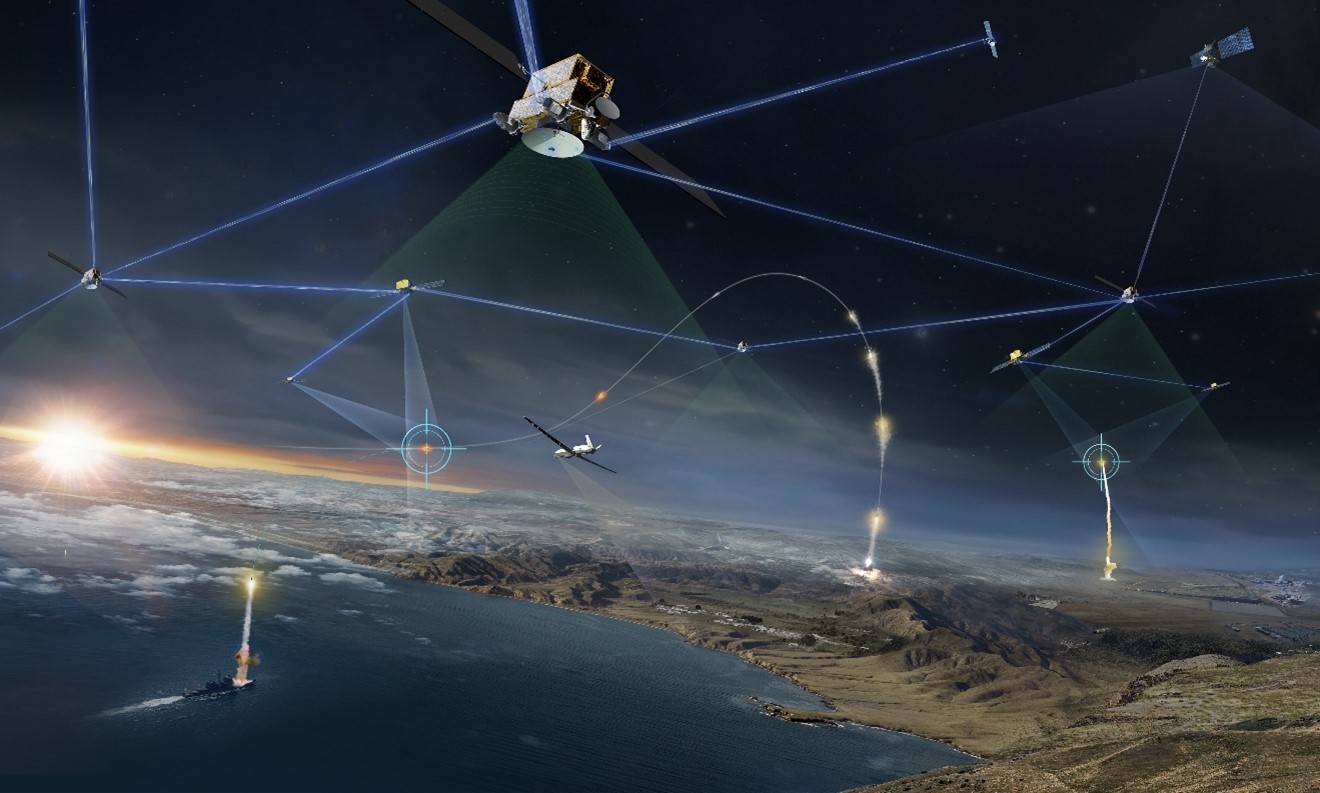
    The Space Development Agency has formerly announced that Northrop Grumman is under contract to develop and build 42 Tranche 1 Transport Layer satellites and 14 Tranche 1 Tracking Layer satellites as part of its Proliferated Warfighter Space Architecture. (Credit: Northrop Grumman)

    WASHINGTON. 18th April, 2023. Northrop Grumman Corporation recently completed a critical design review for its Tranche 1 Transport Layer (T1TL), part of Space Development Agency’s (SDA) low-earth orbit network designed to communicate vital information to wherever it’s needed to support U.S. troops on the ground quickly and securely.

    The Tranche 1 Transport Layer (T1TL) communication satellites will provide resilient, low-latency, high-volume data transport supporting U.S. military missions around the world. Designed to connect elements of an integrated sensing architecture, the network will deliver persistent, secure connectivity, and serve as a critical element for advancing the U.S. Department of Defense’s vision for Joint All Domain Command and Control.

    “We are leveraging our commercial marketplace partnerships to deliver a rapid, affordable, highly effective solution for SDA,” said Blake Bullock, vice president, communication systems, strategic space systems, Northrop Grumman. “Our T1TL solution builds on our decades of end-to-end mission expertise. We are uniquely capable of delivering a credible capability to support the warfighter.”

    SDA formerly announced that Northrop Grumman is under contract to provide the agency with 56 satellites, including the 42 communication satellites in the Tranche 1 Transport layer and 14 for the Tranche 1 Tracking layer, which includes an infrared sensor payload. The Tracking layer program recently completed its preliminary design review. Northrop Grumman is also providing the ground system for both its Transport and Tracking constellations.

    Northrop Grumman is a leading global aerospace and defense technology company. Our pioneering solutions equip our customers with the capabilities they need to connect and protect the world, and push the boundaries of human exploration across the universe. Driven by a shared purpose to solve our customers’ toughest problems, our 95,000 employees define possible every day.

  • Lockheed Martin CubeSats Successfully Validate Essential Maneuvers for On-Orbit Servicing

    Lockheed Martin CubeSats Successfully Validate Essential Maneuvers for On-Orbit Servicing

    • LM 50 satellites demonstrate advanced navigational algorithms and cloud-based operations
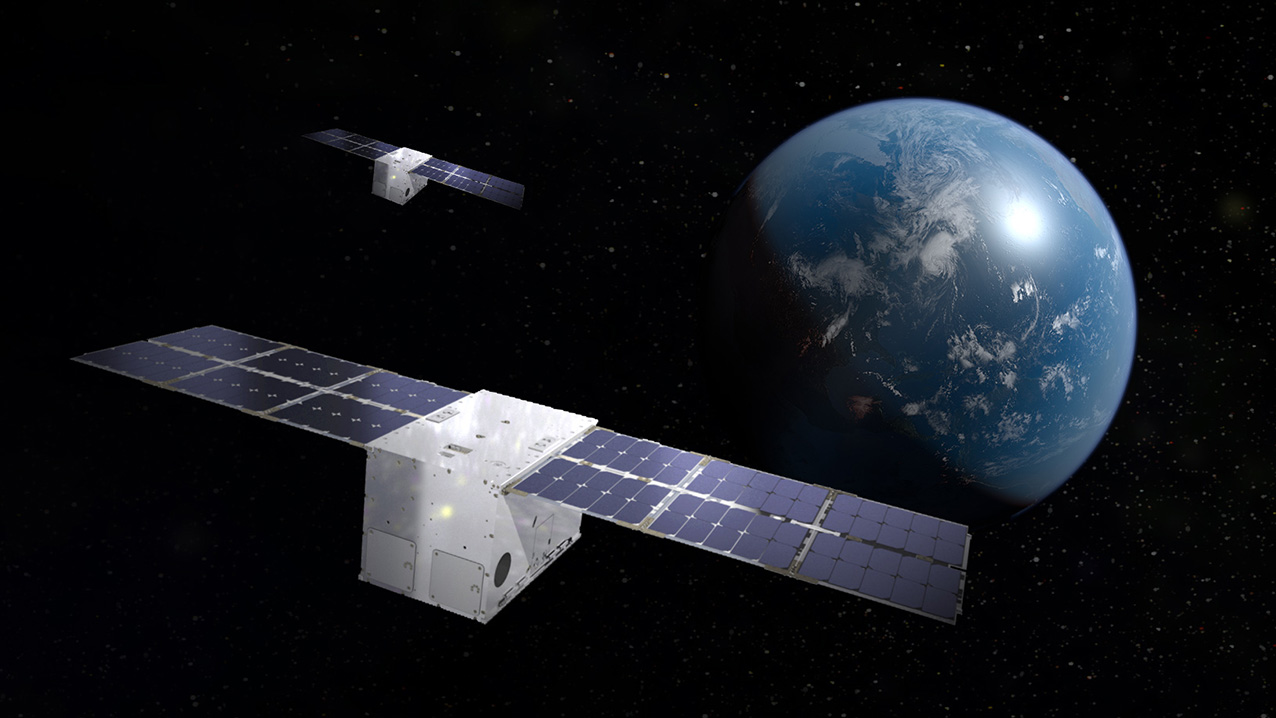
    Lockheed Martin’s In-Space Upgrade Satellite System showcased several new capabilities that include close proximity maneuvers and on-orbit servicing techniques.

    LITTLETON, Colo. Lockheed Martin announced on 18th April, 2023 that its In-space Upgrade Satellite System (LM LINUSS™) accomplished a successful on-orbit demonstration, proving how small satellites can serve an essential role in sustaining critical space architectures. They do this by regularly upgrading existing constellations with new capabilities and extending spacecraft design lifecycles.

    LM LINUSS, a technology demonstration funded internally by Lockheed Martin, is made up of two LM 50™ 12U CubeSats. While on-orbit, the system demonstrated highly-automated rendezvous and proximity operations (RPO), which enables complicated yet precise maneuvering across multi-satellite constellations. This allows on-orbit servicing coordination and upgrades at scale in any orbit. The RPO demonstration was part of Lockheed Martin’s mission to validate essential maneuvering capabilities for future space upgrade and servicing missions.

    Close Proximity Maneuvers Set Stage for Future Mission Capabilities

    During the demonstration, one of the LM LINUSS CubeSats acted as the designated servicing vehicle, navigating a flightpath towards the second CubeSat, which represented the resident space object (RSO). As the servicing vehicle approached the RSO, on-board guidance algorithms made final real-time adjustments to complete its rendezvous operations. Its culminating success was declared when the CubeSats maneuvered in a proximity of one another that demonstrated high confidence in conducting future on-orbit servicing missions for customers.

    “The LM LINUSS pathfinder is an excellent example of how Lockheed Martin is investing in innovation in the real world. Agile development, cloud-based operations, and smallsat platforms came together at speed and in orbit, where the real test of technology occurs,” said Johnathon Caldwell, Lockheed Martin, Vice President and General Manager, Military Space. “Through the accomplishments of LM LINUSS, Lockheed Martin is pioneering how future small and medium class missions will be upgraded on-orbit, and continuing to develop critical, breakthrough technologies that keep our customers ahead of ready.”

    In addition to RPO, the toaster-sized CubeSats also accomplished additional technology demonstrations while on-orbit. Several of these include:

    • Performing automated maneuvers and using artificial intelligence to fly coordinated flightpaths, supporting a variety of operational conditions.
    • Using Lockheed Martin’s Horizon™ 2.0 command and control (C2) software and advanced RPO software.
    • Maintaining connection with a secure cloud-based architecture for mission telemetry, tracking and control.
    • Showcasing the company’s advanced SmartSat™
    • Demonstrating miniaturized Space Domain Awareness capabilities.
    • Validating new onboard high-performance processing, low-toxicity propulsion, inertial measurement units, machine vision, and 3D-printed components.

    LM LINUSS could be considered the most capable pair of CubeSats in geosynchronous Earth orbit today, based on customer community feedback. The spacecraft have higher bus density, payload accommodation and on-orbit processing than any other CubeSat, which helps enable revolutionary mission capabilities in the future. Part of Lockheed Martin’s LM 50 smallsat family, it is the collaborative integration of the company’s mission electro-optical payload deck with a next-generation bus from Terran Orbital Corporation. LM LINUSS and other Lockheed Martin pathfinders are helping create a more sustainable future, safely adding mission life and more.

    “This LM LINUSS demonstration was a success for many reasons, including the fact that our team navigated the inherent challenges of a novel technology and validated our software for future missions,” said David Barnhart, a Technology Director at Lockheed Martin Space. “We will leverage what our team learned from LM LINUSS’ design, development, and operations to continue advancing Lockheed Martin’s innovative vision for on-orbit satellite servicing and upgrades.”

  • Northrop Grumman Unveils New Facility in Albuquerque

    Northrop Grumman Unveils New Facility in Albuquerque

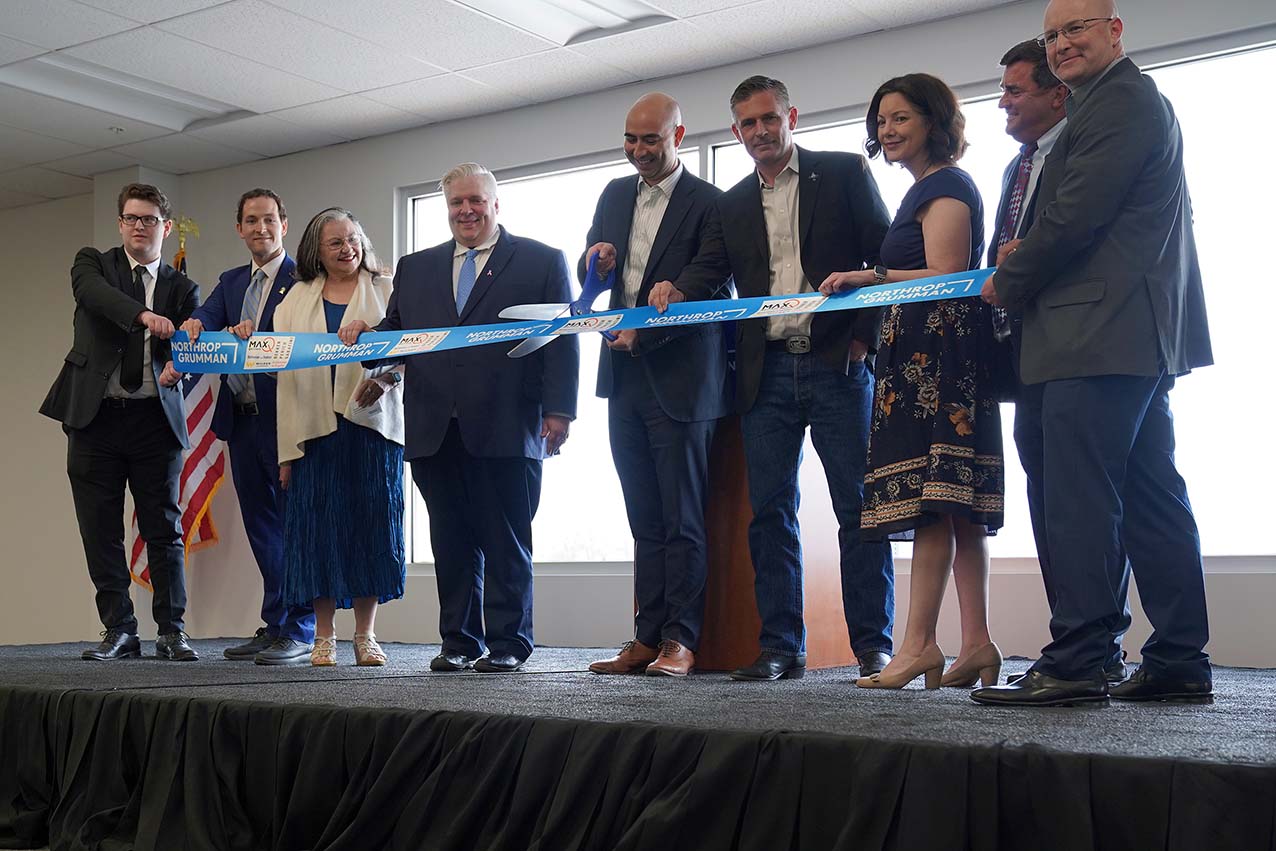
    Northrop Grumman and New Mexico leaders cut the ribbon for Northrop Grumman’s new facility next to Kirtland Air Force Base (Photo Credit: Northrop Grumman)

    ALBUQUERQUE, N.M., 13th April, 2023. Northrop Grumman Corporation opened its new facility to support space systems engineering, integrated mission operations and cybersecurity services for Kirtland Air Force Base and other U.S. military customers.

    U.S. Senator Martin Heinrich and Cyrus Dhalla, vice president and general manager, tactical space systems, Northrop Grumman, attended the event. Matt Verock, vice president, space security systems, Northrop Grumman said, “this close proximity to our customers further enhances our ability to support their rapidly evolving needs in space.”

  • Boeing’s New Military Satellite Integrates Anti-Jam Payload for Enhanced Battlefield Communication

    Boeing’s New Military Satellite Integrates Anti-Jam Payload for Enhanced Battlefield Communication

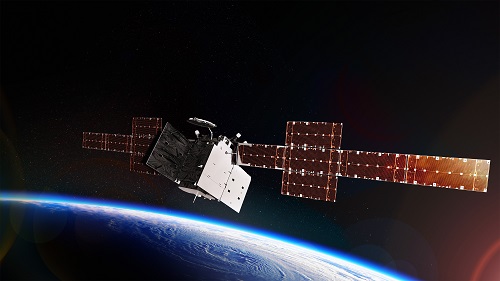
    On-orbit render of Wideband Global SATCOM (WGS)-11 with integrated Protected Tactical SATCOM Prototype (PTS-P) payload. The combination of military satellite communications (MILSATCOM) and anti-jam capabilities underpin the Protected Wideband Satellite design. (Boeing photo)

    EL SEGUNDO, CALIF., 13th April, 2023. Boeing unveiled its Protected Wideband Satellite (PWS) design featuring Boeing’s Protected Tactical SATCOM Prototype (PTS-P) payload hosted aboard the U.S. Space Force’s Wideband Global SATCOM (WGS)-11 spacecraft.

    “The joint force is relying on us to deploy capabilities that enable secure communications in a prolific jamming environment,” said Charlotte Gerhart, Space Systems Command’s Tactical SATCOM division chief at the U.S. Space Force. “We also need mission-relevant speed and affordability, while being mindful of the evolving threat in the battlefield. The Boeing PTS-Prototype payload hosted on WGS-11 is an exciting leap forward for new warfighter capabilities.”

    The combination of military satellite communications (MILSATCOM) and anti-jam capabilities underpin the PWS design. Both programs are based on Boeing’s 702X software-driven technology enabling real-time and automated beam-forming for improved stand-off performance and signal protection.

    “The Protected Wideband Satellite combines significantly upgraded WGS capability with PTS-P’s automated anti-jam features,” said Michelle Parker, vice president of Boeing’s Space Mission Systems. “This capability sets the stage for future generations of protected wideband systems that can operate in both legacy transponded and new onboard processed modes.”

    The program is scheduled for launch in 2024, with on-orbit testing slated for 2025. After on-orbit demonstration, the PTS-P payload will be available to transition for operational use.

    The PTS-P design features automated anti-jam capabilities, including jammer geolocation, real-time adaptive nulling, frequency hopping and other techniques, harnessing the power of the U.S. military’s Protected Tactical Waveform (PTW) to ensure the warfighter can stay connected in a contested environment.

    By flying PTS-P on the WGS-11 spacecraft as part of the WGS constellation, PWS works seamlessly with all the existing WGS user terminals, while allowing gradual fielding of PTW modems in a theater of operation.

    WGS provides the Department of Defense with a broad majority of tactical communications going through the constellation that currently includes 10 satellites.

    As a leading global aerospace company, Boeing develops, manufactures and services commercial airplanes, defense products and space systems for customers in more than 150 countries. As a top U.S. exporter, the company leverages the talents of a global supplier base to advance economic opportunity, sustainability and community impact. Boeing’s diverse team is committed to innovating for the future, leading with sustainability, and cultivating a culture based on the company’s core values of safety, quality and integrity.

  • To Jupiter and beyond: Airbus-built JUICE begins its epic odyssey

    To Jupiter and beyond: Airbus-built JUICE begins its epic odyssey

    • ESA mission will study Jupiter and its icy moons

    Kourou. On 14th April 2023, at 14:00 UTC, JUICE (JUpiter ICy moons Explorer) spread its wings following the Ariane 5 successful lift-off two hours earlier. The ESA spacecraft operations team at the European Space Operations Centre (ESOC) in Darmstadt, Germany, took control of the spacecraft and confirmed reception of the first telemetry and the smooth deployment of the solar arrays. The Airbus-built JUICE is now officially on its way to Jupiter!

    Additional equipment and instruments will be progressively turned on in the next few days and the operations team will run tests to make sure they are all fully operational.

    “After years of work, watching this launch live from our sites across Europe was a very emotional moment for all those who have worked on this incredible mission. This is the best of Europe coming together!” said Michael Schöllhorn, CEO Airbus Defence and Space from Kourou. “I’m eager to see the next big thing coming from the European space community.“

    JUICE: a European shared success

    Bringing together 80 partners across 23 countries and harnessing the brainpower of 2,000+ people, Airbus has designed and built JUICE under contract to the European Space Agency (ESA).

    On its over 5 billion kilometre long journey, the 6.2 tonne JUICE spacecraft will make a series of flybys of Callisto, Ganymede and Europa, collecting data to try to understand whether there is any possibility that the moons and their subsurface oceans could host microbial life. Carrying 10 state-of-the-art scientific instruments, including cameras, spectrometers, an ice-penetrating radar, an altimeter, a radio-science experiment, a particle package and various magnetic and electric field sensors, the JUICE spacecraft will complete a unique 4-year tour of the Jupiter system.

    JUICE is due to arrive at Jupiter in 2031 after a series of gravity slingshots from Venus and Earth to propel it on its way.

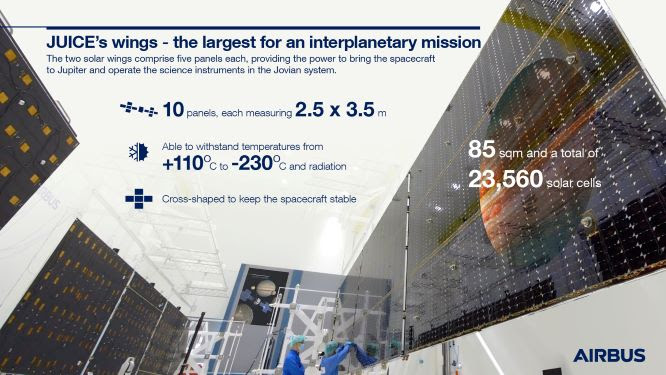
    Airbus has a long legacy of supporting the European Space Agency with all its interplanetary missions. These missions present unique challenges which require pushing space technologies to the limit, and JUICE is no exception, with the largest solar arrays ever built for a science mission.

  • Boeing Delivers Second Pair of O3b mPOWER Satellites to SES

    Boeing Delivers Second Pair of O3b mPOWER Satellites to SES

    • Boeing 702X satellite platform enables high-speed global connectivity from medium Earth orbit.
    • SES’s O3b mPOWER nears its six satellites needed for full global connectivity.
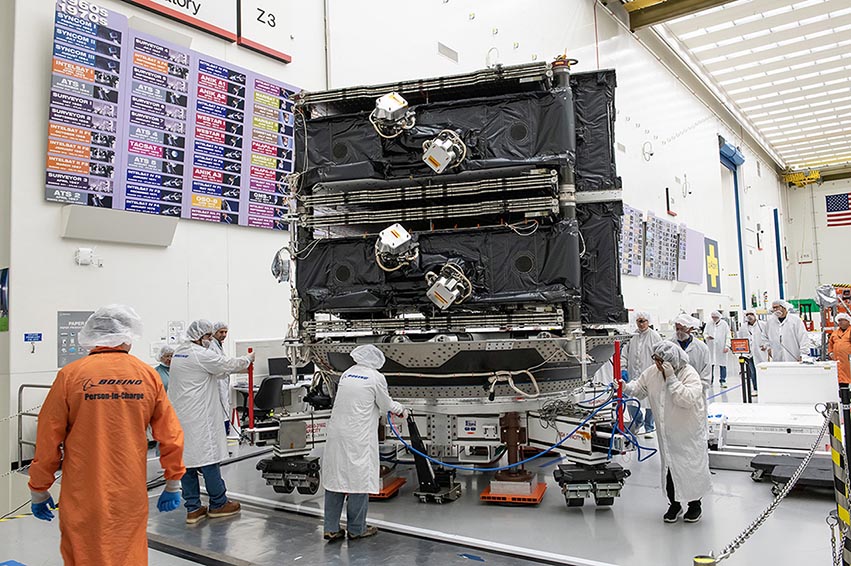
    Boeing team members move the stacked O3b mPOWER satellites through the Boeing satellite factory to prepare the spacecraft for containerization.

    EL SEGUNDO, Calif., 11th April, 2023. Boeing delivered the third and fourth O3b mPOWER satellites to content connectivity service provider SES, with the duo embarking for Cape Canaveral, Florida. The pair will launch to medium Earth orbit (MEO) to provide fiber-like broadband connectivity to people around the world, joining the first two satellites on orbit.

    “As we get ready to launch the next pair of O3b mPOWER satellites in the coming weeks, we are excited to have them join the first two satellites which are currently undergoing rigorous testing as they arrive at their target medium earth orbit,” said Ruy Pinto, Chief Technology Officer at SES. “The early indications from our test program are that the O3b mPOWER system will more than fulfill the expectations of our customers. We will be delivering networks that offer the industry’s best throughput, high availability and predictable performance that are essential for our customers’ critical applications and creating new business opportunities for SES.”

    Boeing is contracted to deliver 11 O3b mPOWER satellites to SES, but just 6 satellites are needed in equatorial MEO to provide global connectivity services. The O3b mPOWER satellites are all-digital with a 702X software-driven payload, providing customers the flexibility and unique advantage to change services and markets to meet data demands.

    “We are proud to have successfully delivered the third and fourth O3b mPOWER satellites and are looking forward to delivering the remaining satellites in the constellation,” said Michelle Parker, vice president of Space Mission Systems at Boeing Defense, Space & Security. 

    With seven more satellites in production, Boeing teams are introducing efficiencies into the manufacturing process. The team has reduced the bus module build time by more than 50 percent, and delivered similar efficiency improvements for payload integration and test, demonstrating the producibility benefits of the highly integrated 702X architecture.

    The first two O3b mPOWER satellites launched in December 2022. To learn more about O3b mPOWER, visit ses.com/O3b-mPOWER.

  • Northrop Grumman Expands Space Technology Capabilities in Huntsville

    Northrop Grumman Expands Space Technology Capabilities in Huntsville

    Northrop Grumman cuts the ribbon on a new, two-building campus in Huntsville, Alabama, expanding its launch and missile defense development capability. (Photo Credit: Northrop Grumman)

    HUNTSVILLE, Ala., 6th April, 2023. Northrop Grumman Corporation cut the ribbon on a new, two-building campus on 6th April, located just outside of Redstone Arsenal in Huntsville, Alabama, expanding its launch and missile defense development capability. This campus will be home to over 1,000 Northrop Grumman employees in the Huntsville area.

    “Our new lab enables us to deliver innovative solutions to our customers on rapid timelines, helping to protect and defend our nation and its allies against evolving threats,” said Scott Lehr, vice president and general manager, launch and missile defense systems, Northrop Grumman. “The enhancements to the facility will also optimize operating efficiencies and provide our team with a dynamic research and development work environment.”

    The Northrop Grumman Redstone Gateway campus will include a hardware-in-the-loop integration lab that provides a robust and resilient cutting-edge capability to Northrop Grumman and its customers. This lab creates an end-to-end environment for engineers to best utilize the DevSecOps methodologies to develop, test, mirror and qualify integrated systems across the Missile Defense engagement chain.

    Company officials were joined by guest speakers U.S. Congressman Dale Strong, Huntsville Mayor Tommy Battle, Madison County Chairman Mac McCutcheon and Huntsville City Council President John Meredith. Also in attendance were senior military partners as well as education, civic and community organizations.

    Northrop Grumman is one of the leading aerospace and defense companies in Alabama, supporting key missile defense customers including the U.S. Air Force, NASA, U.S. Space Force and intelligence communities.

    Northrop Grumman is a leading global aerospace and defense technology company. Our pioneering solutions equip our customers with the capabilities they need to connect and protect the world, and push the boundaries of human exploration across the universe. Driven by a shared purpose to solve our customers’ toughest problems, our 95,000 employees define possible every day.