- Lays foundation stone & dedicates to the nation multiple scientific projects worth more than Rs 5,800 crore
- Shri Narendra Modi releases commemorative stamp and coin on 25th National Technology Day
- “We have to make the nation Viksit and Aatmanirbhar”
- The passion, energy and capabilities of the children and youth today are India’s big strengths: PM
- Pokhran nuclear tests gave the message that India is a peace-loving nation, but it won’t let anyone to harm its sovereignty, integrity & unity: Raksha Mantri
- Shri Rajnath Singh calls for optimum use of country’s powerful human resource to make India strong, prosperous & self-reliant
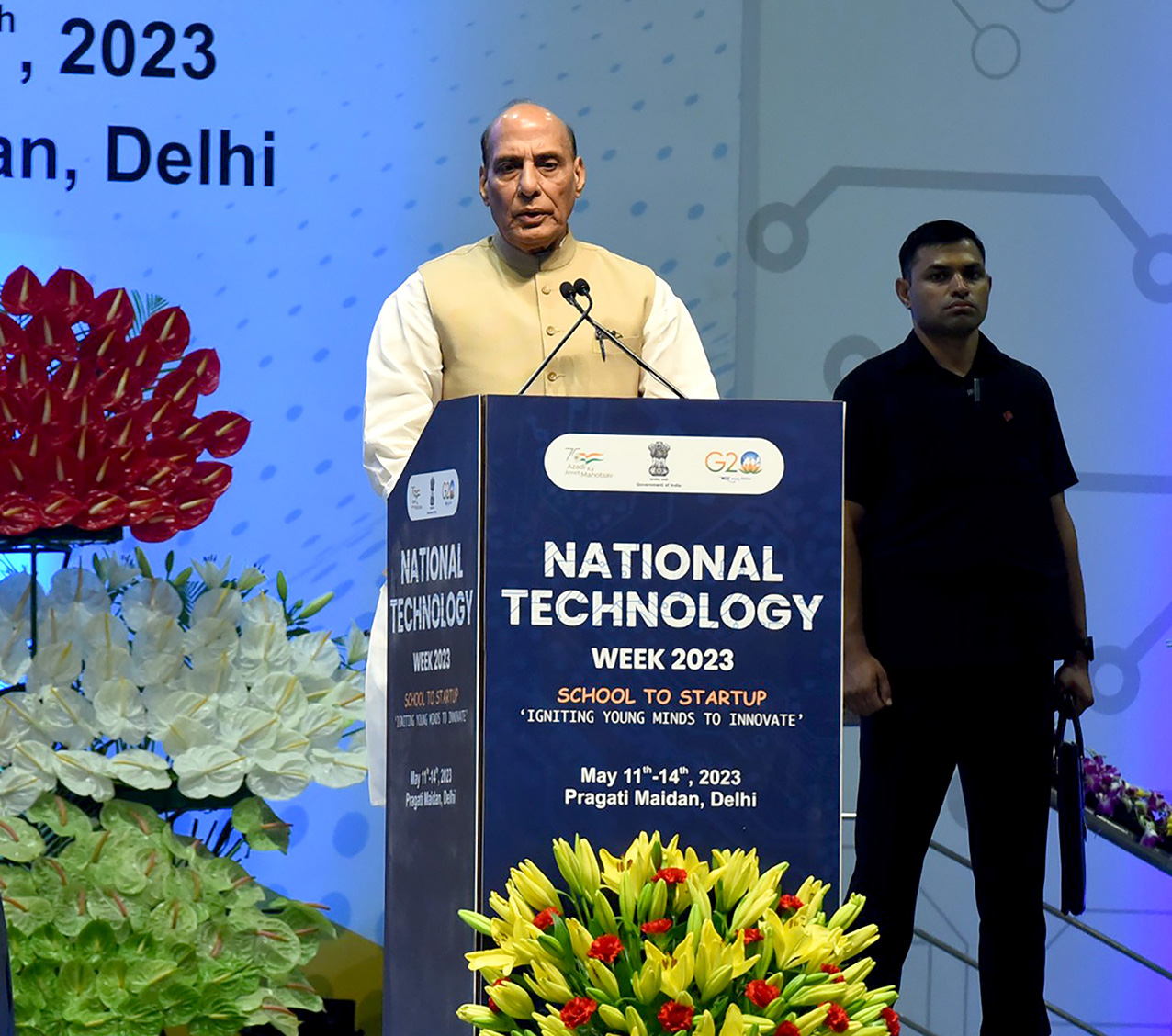
New Delhi, 11th May 2023. Prime Minister Shri Narendra Modi inaugurated the programme marking National Technology Day 2023 at Pragati Maidan in New Delhi on May 11, 2023. The programme also marked the commencement of the celebration of the 25th year of National Technology Day being held from the 11th-14th May. On this momentous occasion, the Prime Minister laid the foundation stone and dedicated to the nation multiple projects related to scientific and technological advancement in the country worth more than Rs 5,800 crore. This is in line with the Prime Minister’s vision of ‘Aatmanirbhar Bharat’ through strengthening scientific institutions in the country.
The projects whose foundation stone was laid include Laser Interferometer Gravitational Wave Observatory – India (LIGO-India), Hingoli; Homi Bhabha Cancer Hospital and Research Centre, Jatni, Odisha; and Platinum Jubilee Block of Tata Memorial Hospital, Mumbai.
The projects dedicated to Nation include Fission Molybdenum-99 Production Facility, Mumbai; Rare Earth Permanent Magnet Plant, Visakhapatnam; National Hadron Beam Therapy Facility, Navi Mumbai; Radiological Research Unit, Navi Mumbai; Homi Bhabha Cancer Hospital and Research Centre, Visakhapatnam; and Women & Children Cancer Hospital Building, Navi Mumbai.
During the programme, the Prime Minister also inaugurated the Expo showcasing scientific & technological advancements made in India in the recent past and also took a walk-through. He also released a commemorative stamp and coin on the occasion.
Addressing the gathering, the Prime Minister said that the 11th of May is one of the most prestigious days in the history of India. He underlined that today marks the day when India’s scientists achieved the stupendous feat in Pokhran which made the entire nation proud. “I can never forget the day when Atal Ji made the announcement of India’s successful Nuclear Testing,” the Prime Minister remarked. He stated that the Pokhran Nuclear Testing not only helped India prove its scientific capabilities but also gave a boost to the global stature of the nation. “In Atal Ji’s words”, the Prime Minister said, “We have never stopped on our journey and never surrendered to any challenge that has come our way.” The Prime Minister conveyed his greetings to every citizen on the occasion of National Technology Day.
Mentioning the futuristic projects that have been inaugurated today, the Prime Minister mentioned the National Hadron Beam Therapy Facility, and Radiological Research Unit in Mumbai, the Fission Molybdenum-99 Production Facility, Rare Earth Permanent Magnet Plant in Visakhapatnam and the various Cancer Research Hospitals and said that it will give a push to the progress of the country with the help of nuclear technology. Talking about LIGO-India, the Prime Minister called LIGO to be one of the foremost science and technology initiatives of the 21st century. The observatory will bring new opportunities for research for the students and scientists, he said.
The Prime Minister reiterated that today, at the initial period of Amrit Kaal, the goals of 2047 are clear before us. “We have to make the nation Viksit and Aatmanirbhar,” said the Prime Minister emphasizing the need for creating an inclusive ecosystem for growth, innovation and Sustainable Development Goals. He underlined the importance of technology at every step and said, India is moving forward with a holistic and 360-degree approach in this regard. “India considers technology as a tool of the nation’s progress, not a means to assert its dominance,” the Prime Minister said.
Praising the theme of today’s event ‘School to Start-ups – igniting young minds to innovate’, the Prime Minister said that India’s future will be decided by the youth and children of today. He said that the passion, energy and capabilities of the children and youth today are India’s big strengths. Quoting Dr APJ Abdul Kalam, the Prime Minister underscored the importance of knowledge and said as India is developing as a Knowledge society, it is taking action with equal force. He elaborated on the strong foundation that has been created in the country during the last nine years to ignite young minds.
The Prime Minister said that more than 10 thousand ATAL tinkering labs in 700 districts have become innovation nurseries. More importantly, 60 percent of these labs are in government and rural schools. He informed that over 75 lakh students are working laboriously on more than 12 lakh innovation projects in Atal Tinkering Lab. This, the Prime Minister said, is a sign of young scientists coming right out of schools and reaching the far corners of the country and emphasising that it is everyone’s duty to handhold them, nurture their talent and also assist them in implementing their ideas. He noted the hundreds of start-ups that have been incubated at Atal Innovation Centres (AIC) and said that it is emerging as the new laboratories of the ‘New India’. “The Tinker-preneurs of India will soon become leading entrepreneurs of the world”, the Prime Minister said.
Quoting Maharishi Patanjali on the importance of hard work, the Prime Minister said that measures taken after 2014 have resulted in big changes in the field of science and technology. “Start-up India Campaign, Digital India, and National Education Policy help India in gaining new heights in the field,” Shri Modi said as he underlined that Science is coming out of the books and turning into patents through experiments.“The number of patents has increased from 4,000 per year 10 years ago to more than 30,000 today. Registration of designs has grown from 10,000 to 15,000 in the same period. The number of trademarks has grown from less than 70,000 to more than 2,50,000,” the Prime Minister informed.
“The India of today is moving forward in every direction that is necessary to become a tech leader”, Shri Modi said. He noted that the number of tech incubation centres in the country has grown from roughly 150 in 2014 to more than 650 today. The Prime Minister also mentioned that India’s Global Innovation Index Rank has gone from 81stto the 40thposition where the youth of the country are setting up their own digital ventures and start-ups. Drawing comparisons with 2014, the Prime Minister mentioned that the number of start-ups in the country has increased from roughly 100 to one lakh recognised start-ups today and it has turned India into the third largest start-up ecosystem in the world. Noting India’s capability and talent, the Prime Minister pointed out that the growth took place at a time when the world is dealing with economic uncertainty. Underlining that the present moment is extremely precious for policymakers, the scientific community, research labs spread across the country and the private sector, the Prime Minister reiterated that even though the School to Start-up journey will be made by the students, it is the stakeholders who must guide and encourage them at all times. The Prime Minister extended his entire support for the cause.
The Prime Minister said that when we move keeping in mind the social context of technology, technology becomes a powerful tool of empowerment. It becomes a tool for removing imbalance and promoting social justice. The Prime Minister recalled the time when technology was beyond the reach of common citizens and things like debit, credit cards were status symbols. But today, UPI has become a new normal due to its simplicity. Today India is among the countries with the highest data use. Rural intent users number has overtaken urban users. JAM trinity, GeM portal, CoWin portal, e-NAM are making technology an agent of inclusion.
The Prime Minister said that the right use of technology gives new strength to society, today the government is using technology for providing services for every stage of life. Online birth certificates, e-Pathshala and Diksha e-learning platforms, scholarship portal, Universal access number during the job period, e-Sanjeevani for medical treatment, and Jeevan Praman for the elderly, such solutions are helping the citizen at every step, said the Prime Minister. He also talked about initiatives in easy passports, Digi Yatra, and DigiLocker as examples of ensuring social justice and enhancing ease of living.
Referring to the rapid changes taking place in the world of technology, the Prime Minister expressed confidence that the youth of India will lead the country in matching this pace and also crossing it. He mentioned AI tools that have emerged as the new game changers, the limitless possibilities in the health sector, and new innovations taking place in drone technology, and the therapeutics sector and said that India must take a lead in such revolutionary technology.
Referring to India’s goal of a self-reliant defence sector, the Prime Minister mentioned Innovations for Defence Excellence (iDEX) and expressed delight that the Ministry of Defence has procured 14 innovations from iDEX worth more than Rs 350 crore. The Prime Minister mentioned initiatives like i-create and DRDO young scientists’ labs and said that these efforts are being given a new direction. Touching upon the new reforms in the space sector, the Prime Minister said that India is emerging as a global game changer and highlighted technologies like SSLV and PSLV orbital platforms. Shri Modi stressed the need to provide new opportunities for the youth and start-ups in the space sector and also touched upon taking the lead in areas of coding, gaming and programming. The Prime Minister also highlighted policy-level initiatives like the PLI scheme at a time when India is increasing its presence in new avenues like semiconductors.
Throwing light on the role of hackathons in innovation and security, the Prime Minister underlined that the government is continuously promoting the hackathon culture where students take up new challenges and emphasised the need for hand-holding and creating a framework for this. He suggested that an institutionalised system be kept in place to address the youth coming out of Atal Tinkering Labs. “Can we similarly identify 100 labs in the country in different areas, which should be made youth driven?”, the Prime Minister asked. Highlighting the special focus areas of clean energy and natural farming, the Prime Minister stressed promoting research and technology. Concluding the address, the Prime Minister expressed confidence that National Technology Week can play an important role in realizing these possibilities.
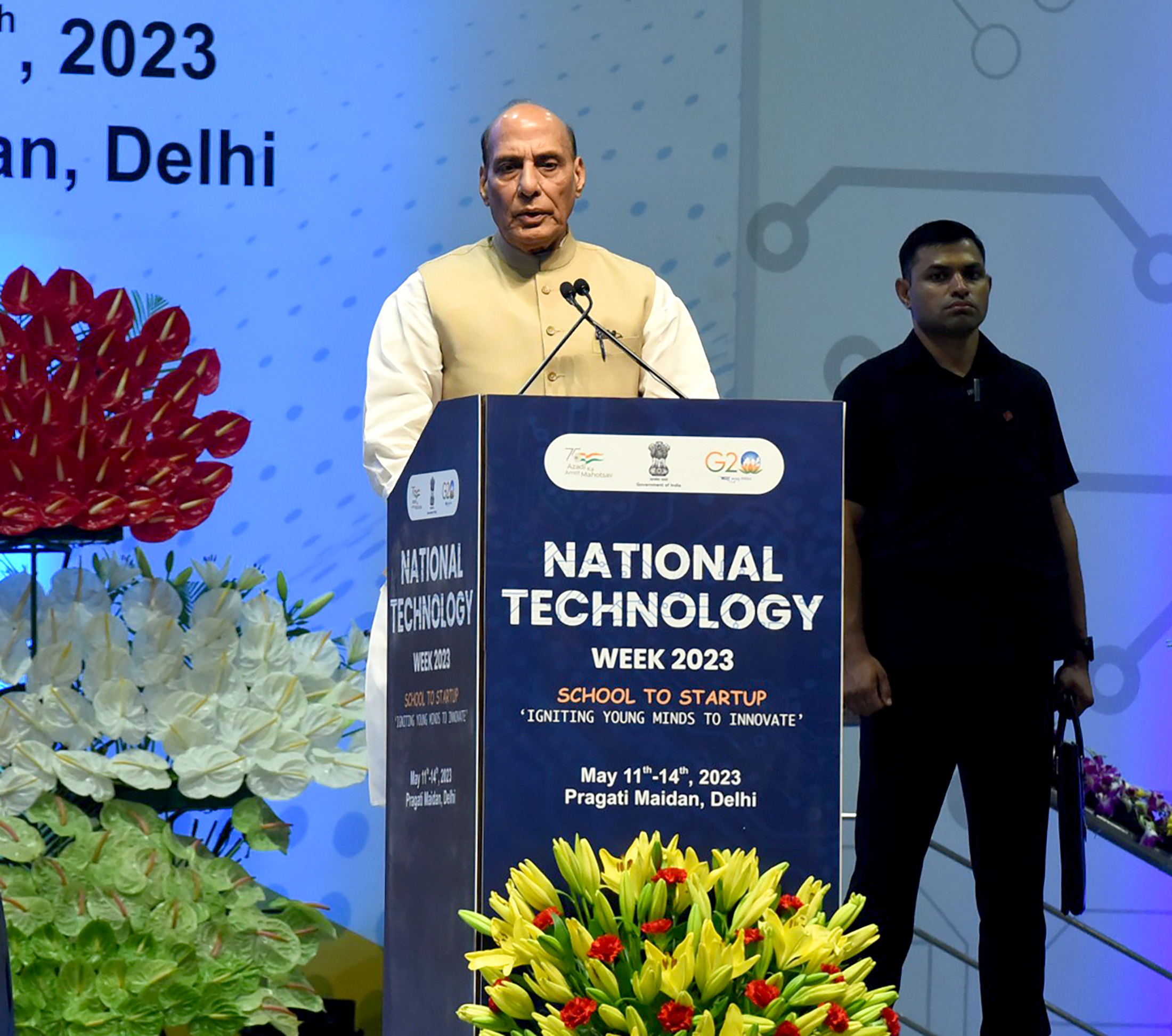
In his address, Raksha Mantri Shri Rajnath Singh asserted that the 1998 Pokhran nuclear tests gave a message to the world that although India is a peace-loving nation which believes in ‘Vasudhaiva Kutumbakam’ and ‘Ahimsa Paramo Dharma’, it will not let anyone to harm the sovereignty, integrity and unity of the nation.
“India has not only wished for peace for itself, but given the message to the world. Visionaries like Lord Buddha and Father of the nation Mahatma Gandhi are India’s gift to the world. We have never invaded any country nor enslaved it. But, the Pokhran tests gave a message that we will give a befitting reply to every step taken against our dignity,” the Raksha Mantri said.
Shri Rajnath Singh termed National Technology Day as an inspiration to adopt a scientific approach while acknowledging the country’s technological achievements. He underlined the importance of science in the progress of a nation, describing it as the source of power. He emphasised that scientific approach motivates the youth to contribute to nation building and ensures holistic development.
The Raksha Mantri was of the view that India, passing through the phase of demographic dividend, possesses a powerful human resource, which has guided it to a respectable position on the world stage. He called for optimum utilisation of this human resource to achieve the goal of a strong, prosperous and developed India.
“Under the leadership of Prime Minister Shri Narendra Modi, we are moving forward with the resolve of Jai Jawan, Jai Kisan, Jai Vigyan and Jai Anusandhan. We have risen in stature on the global stage and the world is witnessing a new ray of hope in India. We will be successful in realising our vision of building a strong and self-reliant ‘New India’,” Shri Rajnath Singh said.
The venue of the event is Pragati Maidan (Hall no 5 & 4), New Delhi. Stakeholder ministries and departments namely Atal Innovation Mission, NITI AAYOG, DST, DRDO, DOS, DAE, CSIR, DBT, MoES, DoT, MEITY, AICTE and DPIIT are participating in this grand expo.
A DRDO Pavilion has been set up, wherein over 30 DRDO laboratories, five DRDO Young Scientists Laboratories (DYSLs), Technology Development Fund (TDF), DRDO Industry Academia-Centre of Excellence (DIA-CoE) and BrahMos are showcasing a range of indigenously designed and developed systems, technologies and innovations in line with the theme of the event. Many DRDO developed innovative technologies & products developed in association with the industry in recent years are being exhibited. 12 MSME and industries are participating under the TDF and DIA-CoE.
In the prestigious Atal Innovation Mission (AIM), the DRDO is displaying Exoskeleton developed by DEBEL Bengaluru, and AI based Audio Transcription Translation for Airborne Communication System Measures (CSM) and associated AI Toolboxes developed by CABS Bengaluru; Laser Based Underwater Communication System developed by SSPL Delhi; and Internet of Battlefield Things (IoBT) developed by DYSL-AI. The DRDO will also organise motivational talks on 13th May being delivered by DYSL Directors and speakers from Industry and academia.