Author: Defence Street Editor

  • Indian Coast Guard Conducts Regional Search And Rescue (SAR) Exercise in Kakinada, Andhra Pradesh

    Indian Coast Guard Conducts Regional Search And Rescue (SAR) Exercise in Kakinada, Andhra Pradesh

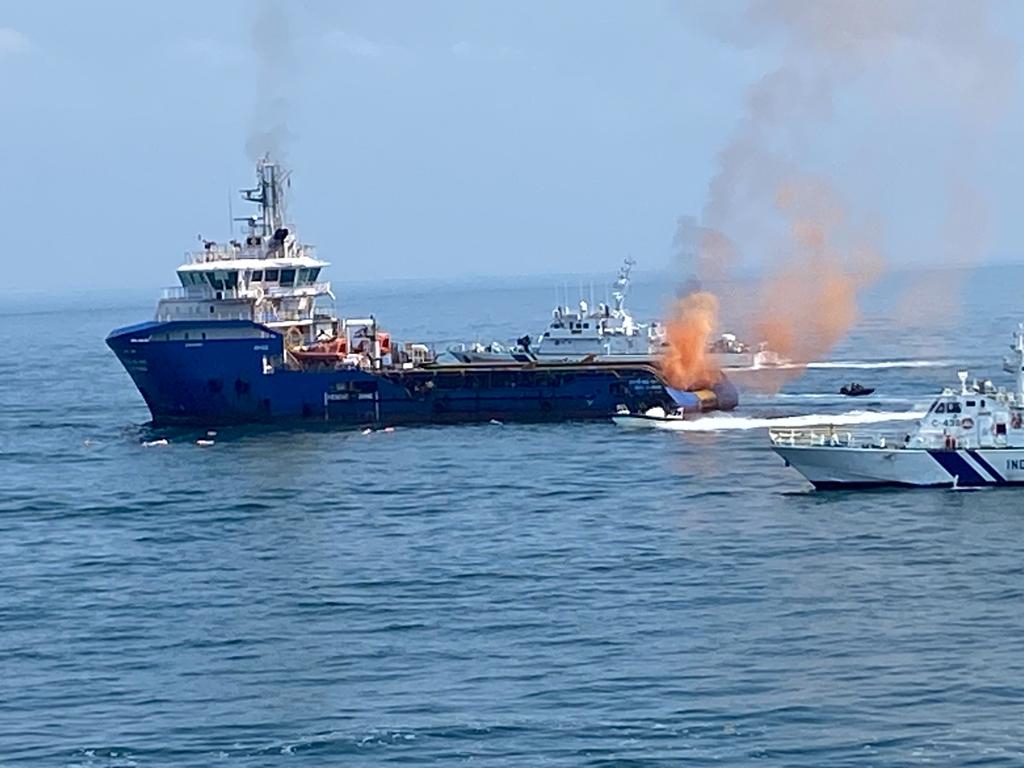
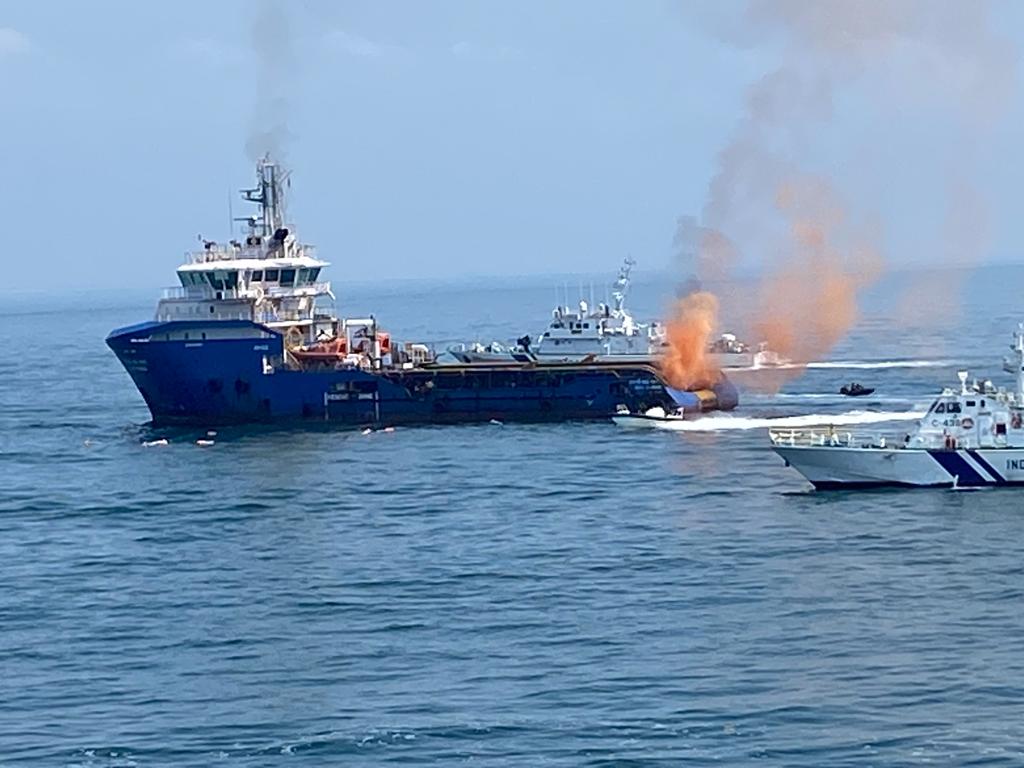
    New Delhi, 29th March, 2023. The Indian Coast Guard conducted Regional Search and Rescue exercise during 28 -29 March 2023 at Kakinada, Andhra Pradesh. The aim of the exercise was to simulate a real time maritime distress scenario and highlight the functioning of Search and Rescue (SAR) organisation for a mass rescue operation. The exercise involved all stakeholders with effective use of available resources towards M-SAR (Maritime Search and Rescue) contingency efficiently.

    The exercise simulated an Offshore Support vessel (OSV) carrying more than hundreds of passengers that reported a distress call of major fire onboard off Kakinada. Maritime Rescue Sub Centre (MRSC) Kakinada coordinated with all resource agencies to save the lives in distress. The state disaster contingency plan was invoked to support the operations at sea. External Fire Fighting of the distressed vessel, Abandon ship drill, deployment of Rescue boat, Jason Cradle, Scramble net, Life raft, life buoy, surveillance by drone, de-induction of casualty rescue by helicopter and medical management were conducted during the exercise. The ashore preparations included setting up of Incident Command Post, Triage for treatment of casualties and necessary facilities for management of critical casualties.

    Sea area off Kakinada was chosen as the venue for the exercise considering the large-scale exploration and production activities in the Krishna Godavari basin which makes the area potential to emergencies necessitating large scale SAR response. The two-day long workshop and exercise enhanced knowledge and understanding, promoting cooperation and coordination amongst member agencies for a Mass Rescue Operation (MRO), wherein the efforts of a single agency may not be sufficient.

  • US Army Selects Northrop Grumman, Teamed with Shield AI, for Future Tactical Unmanned Aircraft System Prototype

    US Army Selects Northrop Grumman, Teamed with Shield AI, for Future Tactical Unmanned Aircraft System Prototype

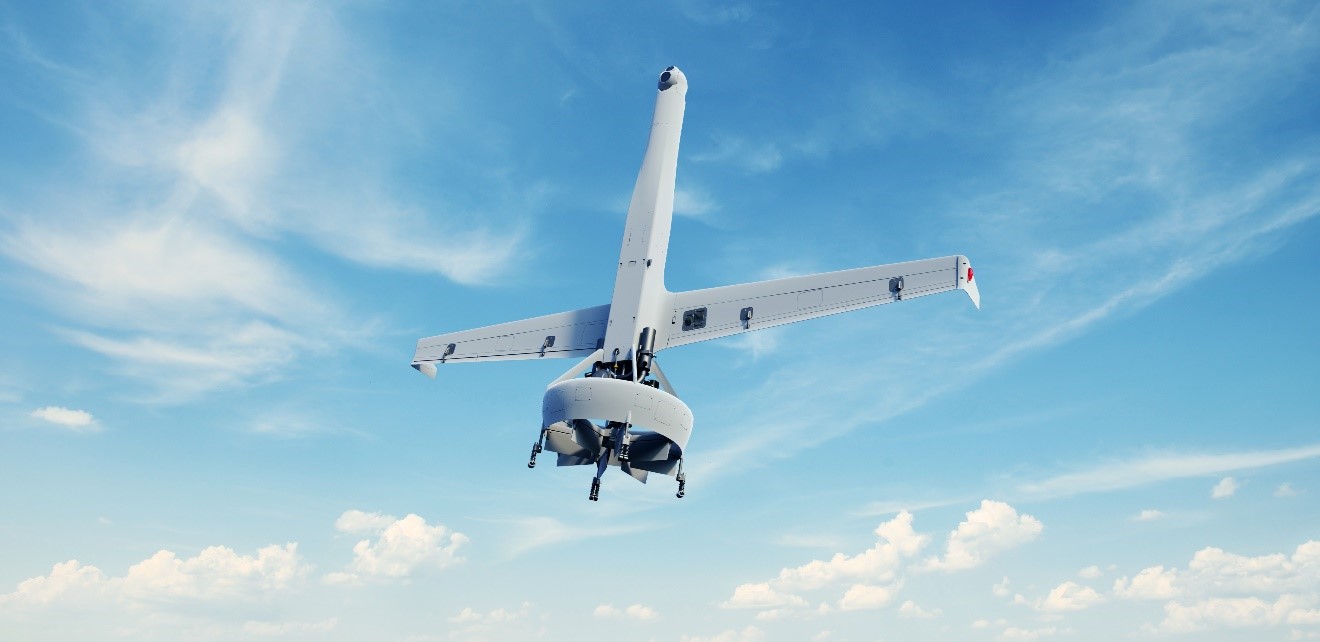
    Northrop Grumman has been chosen by the U.S. Army to participate in Increment 2 of the Future Tactical Unmanned Aircraft System (FTUAS) program. With teammate Shield AI, Northrop Grumman is developing an enhanced-capability version of the innovative V-BAT aircraft, shown in this rendering, to replace the Army’s long-serving RQ-7B Shadow tactical UAS. (Photo Credit: Northrop Grumman and Shield AI)

    MCLEAN, Va., 28th March, 2023. Northrop Grumman Corporation, teamed with Shield AI, has been chosen by the U.S. Army to participate in the Future Tactical Unmanned Aircraft System (FTUAS) competition, Increment 2, to replace the long-serving RQ-7B Shadow tactical unmanned aerial system (UAS).

    Under a seven-week base period contract, the Northrop Grumman-led team will define the modular open-system architecture of an enhanced V-BAT aircraft, including the integration of advanced surveillance and electronic warfare (EW) payloads. The V-BAT UAS is an innovative, agile, compact and lightweight platform that a combat team of two soldiers can rapidly launch and recover in challenging and on-the-move environments.

    “Our team’s enhanced V-BAT embodies more than 30 years of experience designing, delivering and sustaining advanced unmanned aircraft systems, combined with a field-proven platform and production facilities,” said Angela Johns, vice president, autonomous and tactical air systems, Northrop Grumman. “We bring a unique perspective and capabilities to this critical Army mission.”

    Northrop Grumman is teamed with Shield AI, designer and manufacturer of the V-BAT platform, to provide best-in-class solutions for an expeditionary vertical takeoff and landing (VTOL) UAS, capable of persistent aerial reconnaissance for U.S. Army Brigade Combat Teams, Special Forces and Ranger battalions. As a Future Vertical Lift program, the FTUAS is the Army’s premier VTOL unmanned aircraft modernization effort.

    Earlier versions of the V-BAT have supported operations for the U.S. Navy and Marine Corps since 2016. The new enhanced V-BAT is simple to operate, has increased power, a reduced logistics tail and capacity to carry a range of interchangeable payloads, including electro-optical/infra-red, synthetic aperture radar and EW systems, offering long-term adaptability and life cycle management.

    Northrop Grumman is a leading global aerospace and defense technology company. Our pioneering solutions equip our customers with the capabilities they need to connect and protect the world, and push the boundaries of human exploration across the universe. Driven by a shared purpose to solve our customers’ toughest problems, our 95,000 employees define possible every day.

  • Defence Secretary Shri Giridhar Aramane and his Romanian counterpart Mrs Simona Cojocaru hold bilateral talks

    Defence Secretary Shri Giridhar Aramane and his Romanian counterpart Mrs Simona Cojocaru hold bilateral talks

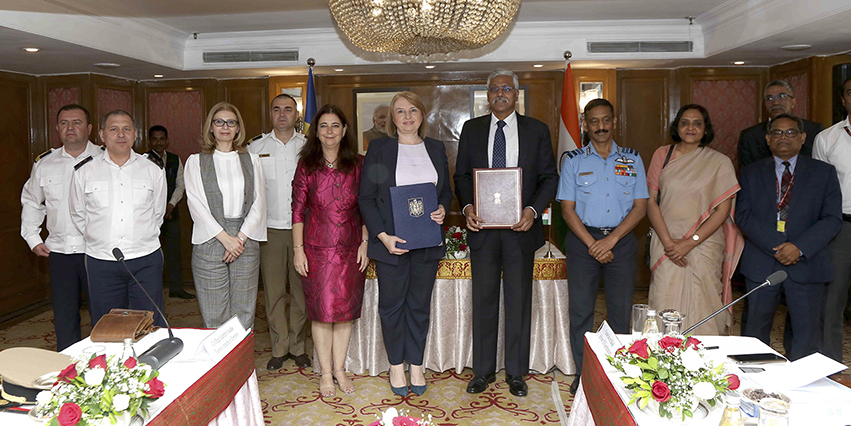
    New Delhi, 28th March, 2023. Defence Secretary, Shri Giridhar Aramane and State Secretary and Chief of the Department for Defence Policy, Planning and International Relations of Romania, Mrs Simona Cojocaru held a bilateral meeting on defence cooperation in New Delhi on March 28, 2023. A wide range of issues encompassing military to military cooperation, military training and courses, defence co-development and co-production and capacity building were discussed in the meeting.

    Both countries signed an Agreement on Defence Cooperation, giving further impetus to bilateral defence cooperation. Both sides shared their perspectives on regional security challenges and expressed their commitment to work together to enhance cooperation in all defence sectors.

  • Maiden Passing Out Parade of Agniveers 01/22 Batch At Ins Chilka

    Maiden Passing Out Parade of Agniveers 01/22 Batch At Ins Chilka

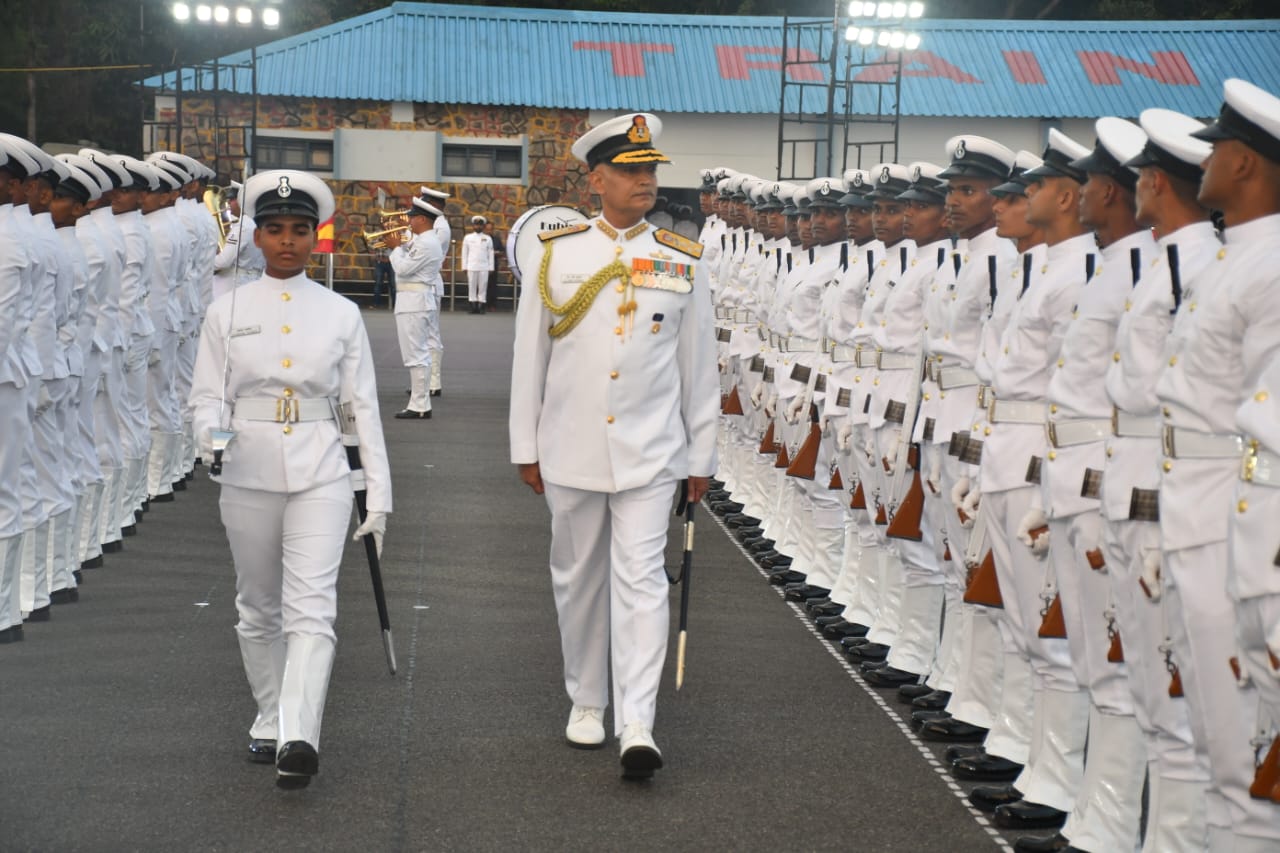
    New Delhi, 28th March 2023. A total of 2585 Agniveers (incl 272 women) of the Indian Navy passed out from the portals of INS Chilka, at Odhisa, in a first of its kind ceremonial, post sunset Passing Out Parade, held on 28 Mar 23 under the aegis of Southern Naval Command. The parade was reviewed by Adm R Hari Kumar, Chief of the Naval Staff, in the presence of VAdm MA Hampiholi, the Flag Officer Commanding-in -Chief, Southern Naval Command, Hon’ble Member of Parliament PT Usha, eminent sports personality Mithali Raj and eminent naval veterans.

    The passing out parade marks, not only the successful culmination of 16 weeks of their ab-initio rigorous naval training, but also the start of a new voyage in the Indian Navy, where men and women will work together to make the Indian Navy a Combat Ready, Credible, Cohesive and Future Proof force.

    During his address, the CNS urged the passing out trainees to hone their skills further and develop a strong foundation of knowledge, willingness to learn and commitment to excel in their respective careers that lay ahead. He also urged them to uphold Navy’s core values of Duty, Honour and Courage, in pursuit of Nation building.

    The Chief Guest also awarded medals and trophies to the meritorious Agniveers on the occasion. Amalakanti Jayaram, Agniveer (SSR), Ajith P, Agniveer (MR) were awarded Chief of the Naval Staff Rolling Trophy and Gold Medal for Best Agniveer SSR & MR respectively in men’s category. Khushi, Agniveer (SSR) was the Best Woman Agniveer in the overall order of merit. A Rolling Trophy, instituted to commemorate the vision of Late General Bipin Rawat – the first CDS was awarded to her by the daughters of Late Gen Bipin Rawat.

    In the day, during the Valedictory function, the Chief of the Naval Staff gave away the overall Championship Trophy to Eklavaya Division and Runners Up Trophy to Angad and Shivaji Division. He also unveiled the summer edition of Ankur – the bilingual trainees’ magazine of INS Chilka, in the presence of Flag Officer Commanding-in-Chief Southern Naval Command and Commodore NP Pradeep, Commanding Officer, INS Chilka.

  • NATO Support and Procurement Agency orders additional Airbus A330 MRTT

    NATO Support and Procurement Agency orders additional Airbus A330 MRTT

    Getafe, 28th March 2023. The NATO Support and Procurement Agency (NSPA) has ordered an additional Airbus A330 Multi-Role Tanker Transport (MRTT), increasing the Multinational MRTT Fleet (MMF) to 10 aircraft.

    This announcement follows Belgium’s decision to increase its number of hours in the programme with an additional 1,100 flight hours per year. The Multinational Multi Role Tanker Transport Fleet (MMF) provides strategic transport, air-to-air refuelling and medical evacuation capabilities to its six participating nations: Belgium, the Czech Republic, Germany, Luxembourg, The Netherlands and Norway. These Nations signed the Memorandum of Understanding that enables them to share costs proportionally according to the national commitment of flight hours per year.

    “Since the arrival of the first aircraft in 2020 and especially since the beginning of the war in Ukraine, the MMF is protecting European sovereignty and showing its capabilities as a multirole tanker,” said Jean Brice Dumont, Head of Military Air Systems at Airbus Defence and Space. “With this new order, NSPA has already acquired one out of four optional MRTTs requested beyond the nine aircraft contracted earlier, demonstrating the level of customer satisfaction.”

    MMU already operates seven A330 MRTTs and reached Initial Operational Capability ceremony on March 23rd. Full Operational Capability is expected in mid-2024.

    Its success relies on the excellent cooperation between NATO, the participating nations and industry. The programme also stands as an example on how nations can cooperate, pooling and sharing resources to get ongoing access to state of the art capabilities.

    The unit has been deployed in NATO’s Eastern Flank, as well as for the evacuation of Afghanistan civilians and refugees and for multinational exercises in the Indo-Pacific region with the German Air Force, among other missions.

    Two of the tankers yet to be delivered are expected to enter service in 2024, while this new aircraft will arrive at the end of 2026. The MRTTs from MMF operate from MMU Main Operating Base (MOB) in Eindhoven (Netherlands) and the Forward Operating Base (FOB) in Cologne (Germany).

  • A321XLR programme completes second cold-weather testing campaign

    A321XLR programme completes second cold-weather testing campaign

    This week the A321XLR development flight-test aircraft (“FT3”, MSN11080) dedicated to the cabin returned from its four-day cold-weather ground testing at Iqaluit in northern Canada.

    A few weeks earlier, one of the other A321XLR test aircraft (“FT2”, MSN11058) made a similar visit to Iqaluit. On that initial occasion the mission was to test the operation of the hydraulics and other systems at extreme cold temperatures – after an overnight soak at minus 40 degrees Centigrade.

    Ground testing the water and waste system

    “The objective of this most recent cold-weather campaign was to validate the aircraft operation in cold weather for ground operations,” says Tuan Do, Lead Flight Test Engineer.

    He notes: “This time around we tested the cabin water and waste system – which required the temperatures inside the unheated cabin to ‘soak’ at below -15 degrees Centigrade overnight. To this end, several cold soaks were conducted over successive nights with the doors left open, while the outside temperature was around minus 20 degrees Centigrade.

    In each case different heating and insulation configurations were applied for subsequent comparative analysis by the engineering department.”

    As part of this, a new ‘cold weather option’ available for A321XLR operators, was tested in real conditions for the first time – it adds heaters to ensure the system doesn’t freeze-up overnight. The tests also validated the ‘standard aircraft’ configuration – ie. without the optional package activated – and a weight-saving opportunity configuration, with less insulation.

    Of course, every airliner cruises at high altitudes where the outside temperatures are much lower. However, inside the cabin the water and waste systems operate in above zero temperatures. This is why ground testing (in a completely powered-down state) is specifically called for – so that the ambient environment inside the cabin and below the passenger deck, where many systems are located, can cold-soak at sub-zero temperatures.

    Hydraulics, oil and electrical system testing at -40 degrees Centigrade

    “During our first five-day visit to Iqaluit a month ago, when we powered-up the aircraft in the morning, we would ‘wake-up’ the hydraulics, electrics, and other systems and see how long it took to operate the aircraft and get it ready for taxiing and takeoff.”

    “There were also some flights to validate the landing gear operation in very cold temperatures. Notably, the A321XLR features an uprated landing gear – to support the higher maximum take-off weight of the aircraft (whose MTOW is 101 metric tonnes, vs 97 tonnes for the A321LR). Consequently, the shock-absorbers on this new variant are designed to handle higher loads compared with those on the other A320 Family members.

    The test objective was to check the ‘weight-on-wheels’ signal, so the aircraft knows when the main landing gear shock absorbers are compressed or extended.

    “There are many systems on the aircraft which depend on the weight on wheels signals to tell them whether the aircraft is in flight or on ground. So during our first visit to Iqaluit we verified how the weight-on-wheels function is affected by the physical changes in the main landing gear, and how shock absorber stiffness is affected by cold temperatures,” recalls Tuan.

    Another design feature of the -XLR related to hydraulics which needed to be evaluated in the cold environment were new hydraulic lines which pass through Rear Centre Tank, located aft of the Landing Gear bay. “Our design office colleagues wanted us to check that the routing of the pipes did not significantly affect the hydraulic temperatures and operations after warm-up of the aircraft,” notes Tuan.

    Other cold weather challenges, applicable for any aircraft, include ensuring that hatches don’t freeze shut, or that the systems in general don’t freeze up – not only the water pipes, oil and hydraulics systems, but also the electrical system, especially batteries. “Batteries don’t hold as much charge or provide as much power output when they are at low temperatures. Meanwhile, oil and hydraulics become very viscous at very low temperatures which makes it hard to move flight control surfaces around and drive pumps etc. So you need to heat the aircraft up and its pipework to be able to operate the aircraft,” explains Tuan.

    Human challenges

    The challenges behind the cold weather campaign also include human ones,” he notes. “We have maintenance and ground support teams who need to prepare and configure the aircraft, and check everything outside. They need to have the right clothes and equipment compatible with operations outside. But even with those provisions, the wind-chill factor is so strong in Iqaluit that it’s difficult. You can only work for a limited time outside, so we have shifts to ensure that nobody stays outside for too long.”

    On-site Airbus for its part, had brought a team of more than 30 people. These included: six flight crew – pilots, flight test engineers, and a test-flight engineer; a cabin specialist engineer; a maintenance team – comprising mechanical specialists, electrical specialists, quality inspectors; instrumentation specialists; systems design specialists; technical photographers; as well as an operations colleague to oversee the logistics for the overall journey.

    The human challenges are not simply on-site in Iqaluit, rather, they begin much earlier. The flight-test engineers will have agreed the test requirements with the design engineers’ office several months in advance, and from that will have prepared the campaign mission plan together with the mission flight-crew and ‘test-flight’ engineer colleagues. Together they determine how they need to configure the aircraft inside and out, when to start taxiing and then take-off, and what the ambient and systems temperature conditions should be etc. They will sequence all the testing and planning of the campaign, and of course, ensure that the whole mission is conducted safely.
  • Minister of Civil Aviation Shri Jyotiraditya M. Scindia inaugurates direct flight between Ahmedabad and Gatwick

    Minister of Civil Aviation Shri Jyotiraditya M. Scindia inaugurates direct flight between Ahmedabad and Gatwick

    • The flight will operate three days a week
    • This connectivity will boost trade and commerce and help Indian students studying in the UK

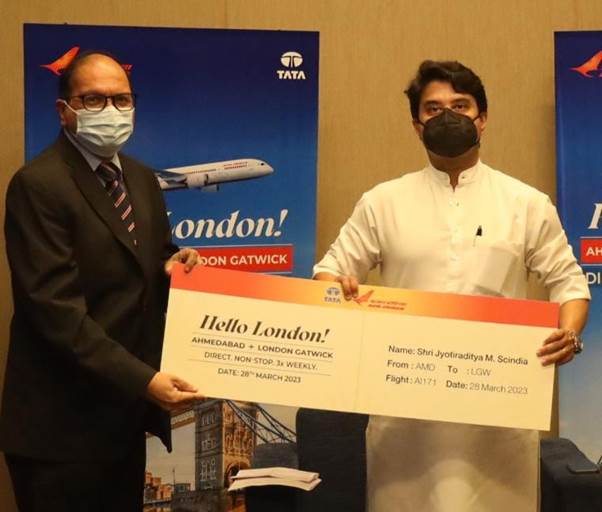
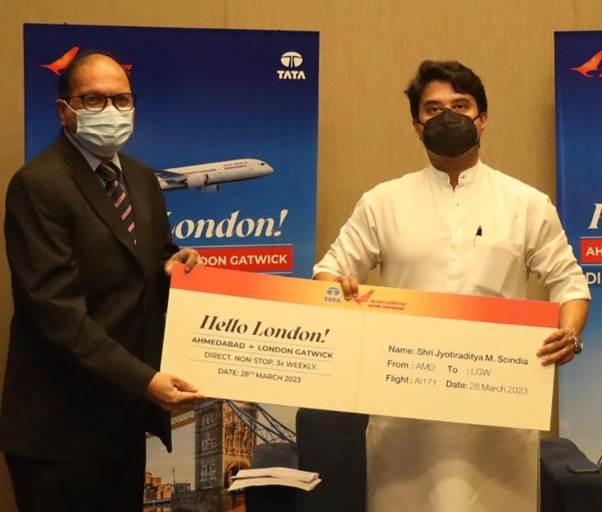
    New Delhi, 28th March, 2023. Union Minister of Civil Aviation & Steel, Shri Jyotiraditya M. Scindia inaugurated a direct flight between Ahmedabad and Gatwick today.

    The non-stop flight between Ahmedabad and Gatwick will be operated by Air India commencing from 28th March, 2023 as per the following schedule:

    Flt No. From To Freq. Dep. Time (LT) Arr. Time (LT)
    AI171 AMD LGW Thrice a week 1150 1640
    AI172 LGW AMD Thrice a week 2000 0850+1

    Image

    In his address, Shri Jyotiraditya M. Scindia said that this new air connectivity will bring in new opportunities for trade and commerce and help Indian students studying in the UK.

    Speaking on the connectivity in Ahmedabad, the minister stated that the Sardar Vallabhbhai Patel International Airport, Ahmedabad currently has the capacity to handle 50 lakh domestic and 25 lakh international passengers. The government aims to increase the passenger capacity of Ahmedabad to 1.60 crore.

    In 2013-14, Ahmedabad was connected to only 20 destinations and under the leadership of PM Narendra Modi, in the last 9 years the connectivity has increased to 57 destinations, he added. In last 9 years, the weekly air traffic movement from Ahmedabad has increased from 980 per week to 2036 per week, increase by 128%.

    On the development of civil aviation in Gujarat, Shri Scindia said that the Union Government has given specific attention to the infrastructure development in the state. A new terminal has been developed in Kandla, a new integrated terminal building in Surat with the cost of Rs 250 crore, and a new ATC Tower cum technical building in Vadodara.  Currently, Gujarat has 10 airports, and with the development of two new greenfield airports in Dholera with a cost of Rs 1305 crore and Hirasar Rajkot with a cost of Rs 1405 crore this number will increase to 12.

    In Gujarat, the number of flights operational from airports of Gujarat has increased to over 2500 from 1175 in 2013-14. Under the RCS UDAN scheme, Gujarat has been awarded 83 routes and 55 of them have already been operationalized and the rest will be operational soon.

    Shri. Balwantsinh Rajput, Minister, Government of Gujarat; Shri Rajiv Bansal, Secretary, Ministry of Civil Aviation and Shri. Campbell Wilson, CEO-Air India were also present.

  • Port Visit of INS Sumedha at Algiers

    Port Visit of INS Sumedha at Algiers

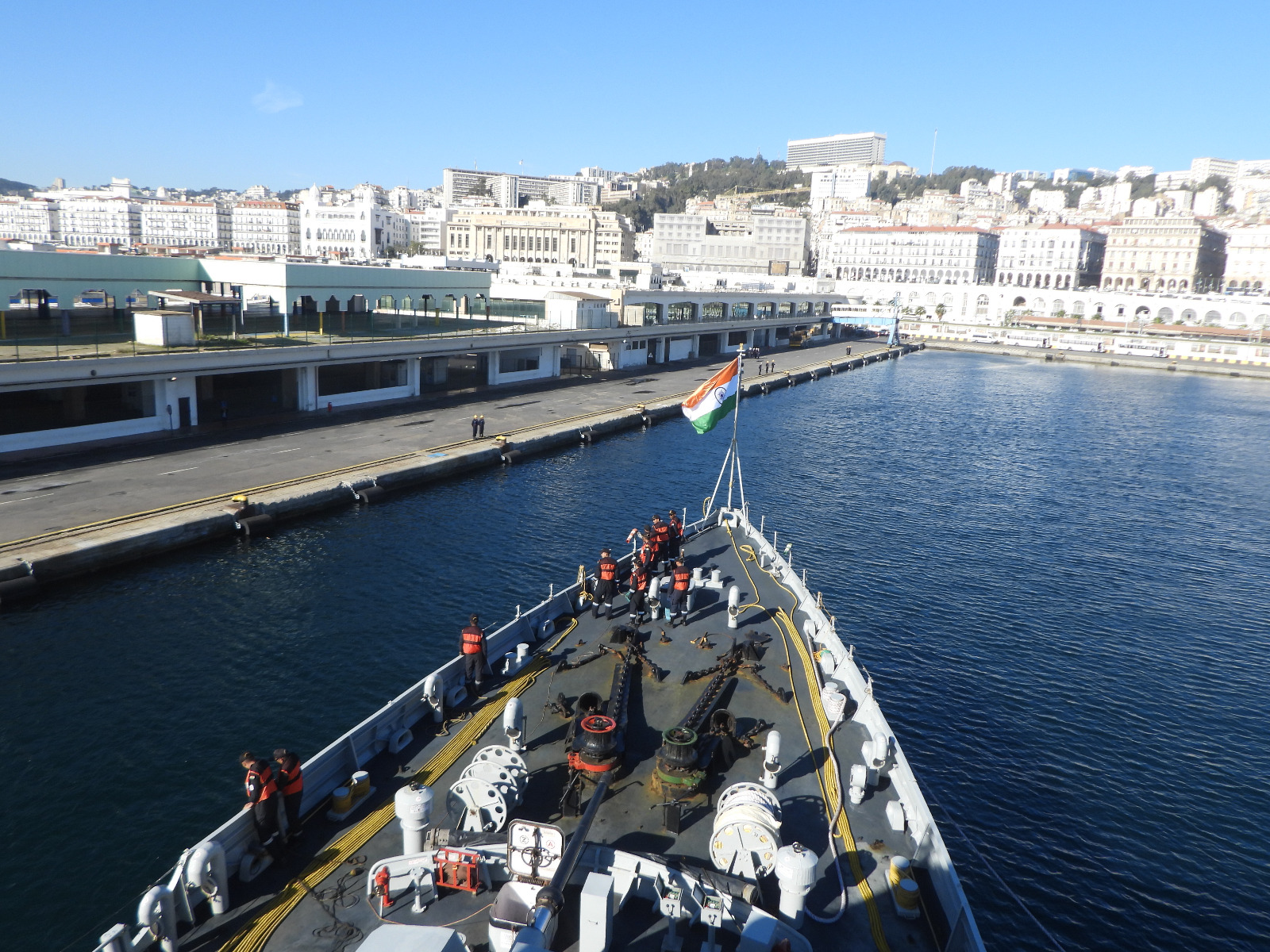
    New Delhi, 28th March, 2023. INS Sumedha, presently deployed in the Mediterranean Sea, entered Algiers, Algeria on 26 Mar 23 for an operational turn around. The ship was received at Port Algiers by officers of the Algerian Navy and officials from Embassy of India, Algiers.

    The visit is aimed at strengthening bilateral ties and enhancing maritime cooperation and interoperability between the two navies. It also demonstrates the Indian Navy’s outreach to friendly maritime nations.

    During the visit, the two navies will share best practices and experiences through cross deck visits, professional interactions, sports fixtures and cultural visits.

    Indigenously built, INS Sumedha is a stealth offshore patrol vessel constructed at Goa Shipyard Ltd and is fitted with a state-of-the-art weapon and sensor package. She is routinely deployed for fleet support operations such as anti-piracy patrol, SAR, HADR, surveillance and escort missions. She can carry an Advanced Light Combat Helicopter onboard.

  • India will continue to work with African nations to promote regional security, stability & enhance defence capabilities, says Raksha Mantri during 1st India-Africa Army Chiefs’ Conclave in Pune

    India will continue to work with African nations to promote regional security, stability & enhance defence capabilities, says Raksha Mantri during 1st India-Africa Army Chiefs’ Conclave in Pune

    • Reiterates support to partner-countries in all defence-related matters
    • Shri Rajnath Singh invites African companies to explore Indian defence equipment & technologies to fulfill their security needs
    • “India-Africa ties drive South-South cooperation to build a multi-polar world order, more responsive to the aspirations of developing countries”

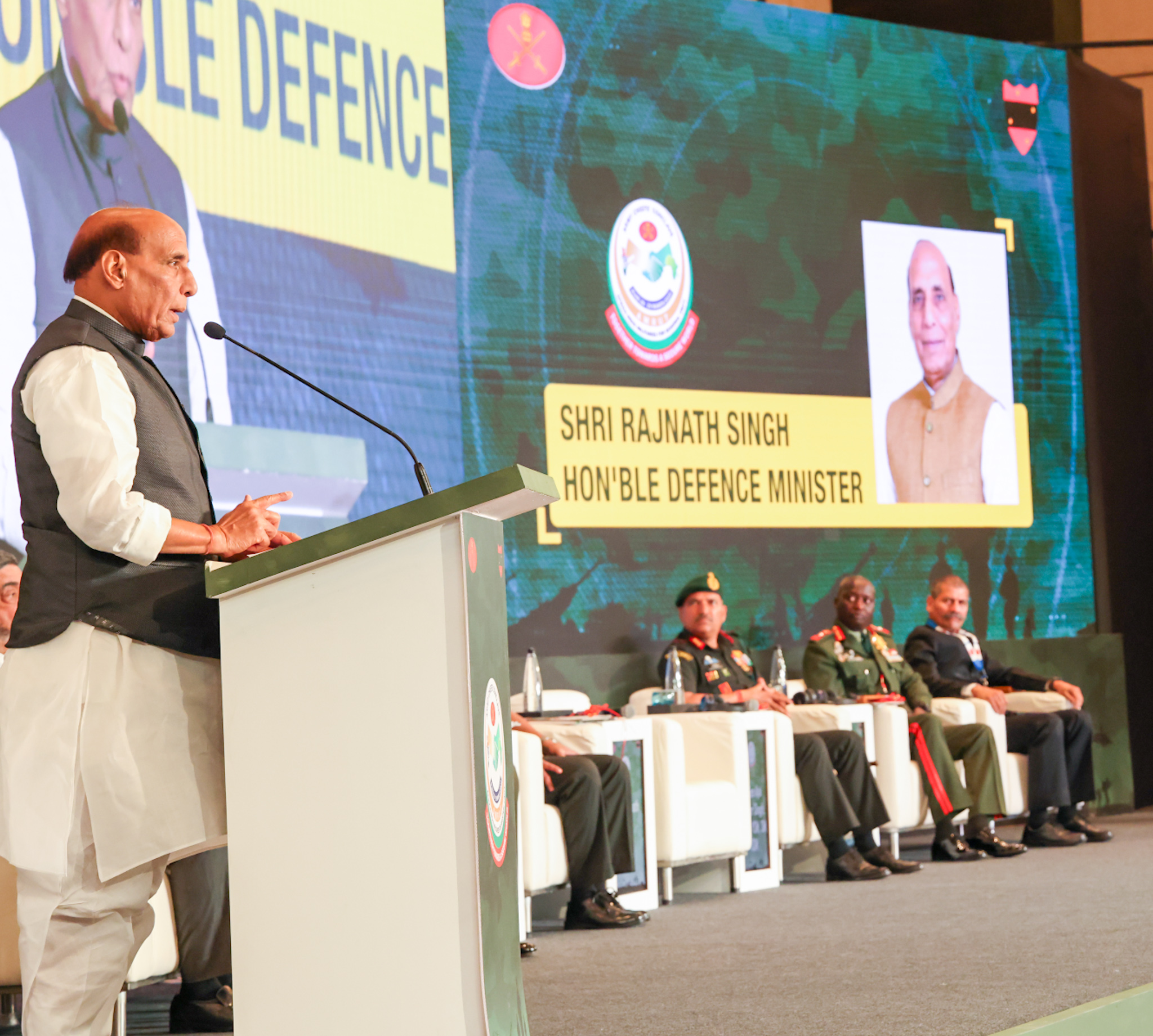
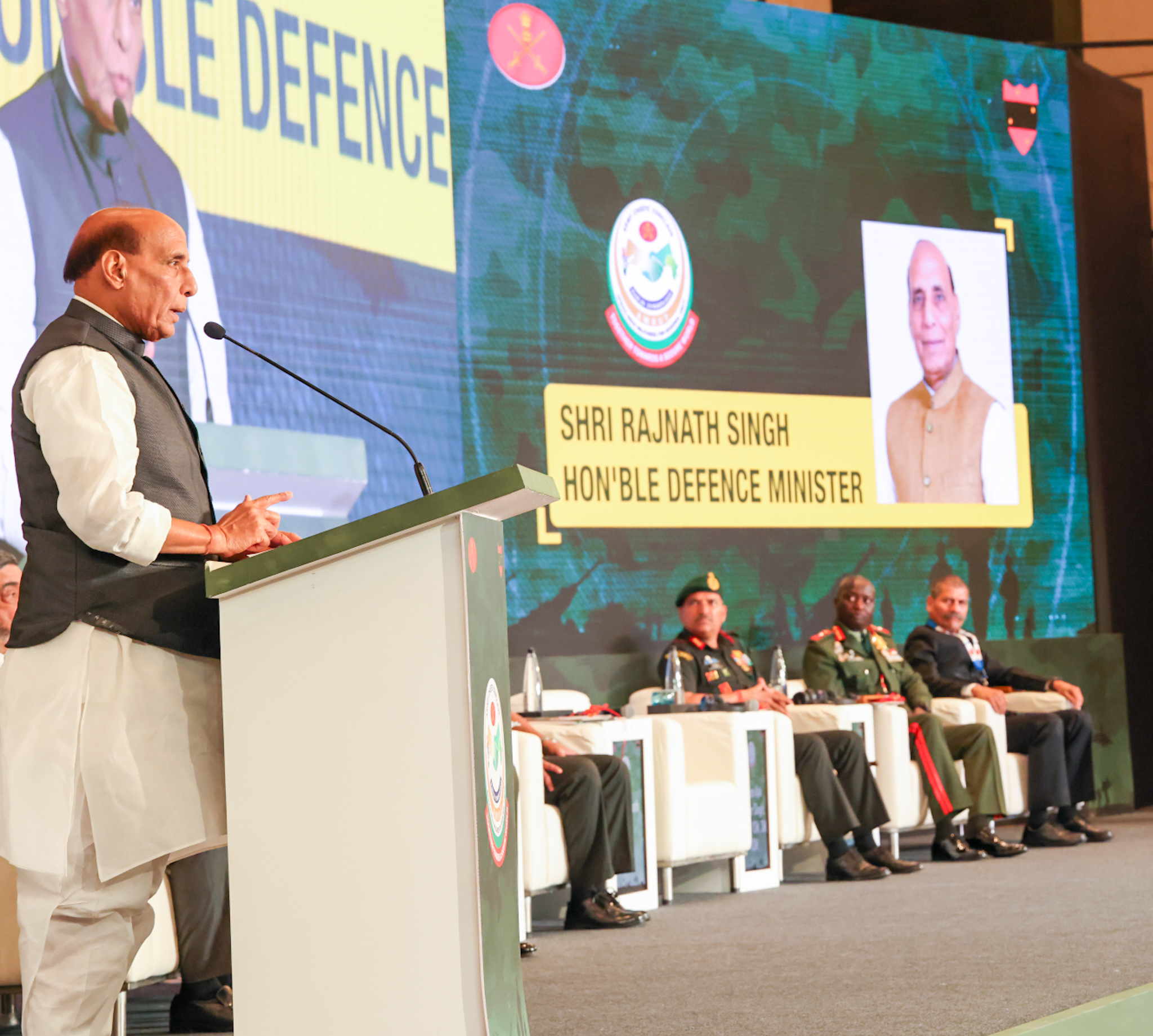
    New Delhi, 28th March, 2023. India will continue to work with African nations to promote regional security, foster stability and enhance the defence capabilities together. This was stated by Raksha Mantri Shri Rajnath Singh during the first edition of India-Africa Army Chiefs’ Conclave organised on the sidelines of 2nd Africa-India Joint Exercise ‘AFINDEX’ in Pune, Maharashtra on March 28, 2023. The Conclave was attended by Chief of the Army Staff General Manoj Pande and Chiefs & representatives of 31 African nations, along with other civil and defence dignitaries.

    Shri Rajnath Singh reiterated India’s commitment to provide support to African partner-countries in all defence related matters, including capability enhancement of their Armed Forces, to ensure their economic growth and social development. He emphasised that the full potential of a nation’s progress can be realised only when its security is ensured.

    “We believe that preservation of individual human rights such as the right to life and personal liberty, right to employment, right to livelihood, etc. are dependent on a strong and effective state apparatus which can ensure the Rule of Law as well as promote economic growth & social development. Development can only take place in a safe and secure environment. Though many of us have come a long way since our independence, there are many African countries where the capacity building of state systems is still a work in progress,” the Raksha Mantri said, while emphasising the need to build robust state structures which can cater to the needs and aspirations of the people.

    India has been at the forefront of providing training to the Armed Forces of African nations and equipping them with necessary skills to face the security challenges of the 21st century. The training programmes cover a wide range of areas, including counter-insurgency operations, peacekeeping, maritime security and specialised training in new domains such as cyber warfare and drone operations. It also encompasses training civilians in areas such as disaster management, humanitarian aid and medical assistance. A large number of African Countries’ Armed Forces personnel continue to visit India for training in different areas.

    The Raksha Mantri added that the Joint Exercises between India and African nations provide an excellent opportunity for the Armed Forces to learn from each other and promote interoperability. He termed ‘AFINDEX’ as a reflection of India’s continued focus on African nations to develop capacities and enhance mutual capabilities. “As maritime neighbours linked by the Indian Ocean, our cooperation in maritime security & hydrography and countering terrorism & extremism will be essential for regional peace and prosperity,” he said.

    Shri Rajnath Singh described capacity building in terms of defence equipment and platforms as another critical aspect of India’s military cooperation with its Africa partners. He invited the African countries to explore Indian defence equipment and technologies to fulfill their security needs. “India has emerged as a leading defence exporter in recent years. A defence manufacturing ecosystem has been created here which has the advantage of abundant technical manpower. The Indian defence industry can work with you to fulfil your defence requirements. With the aim to empower our African friends to indigenously meet their defence requirements, we are also committed to sharing our expertise and knowledge in defence manufacturing, research and development,” he said.

    Elaborating further on the India-Africa ties, the Raksha Mantri stated that “we are united by the common goals of eradicating poverty, achieving sustainable development, promoting peace & harmony and improving the quality of life of the people.” He added that this partnership drives the South-South cooperation to build a truly multi-polar world order which is more responsive to the aspirations of developing countries.

    Shri Rajnath Singh pointed out that the people of India and Africa together represent a third of humanity, a demographic dividend which has to be used wisely. He called for turning this huge human resource into an engine of growth and development. “Many African nations have the fastest rate of growth of population in the world. As per some projections, by 2050, there would be one African, out of every four people in the world. Therefore, if humanity has to develop, Africa has to develop. Today, Africa is today home to more than a billion vibrant people, with more than two thirds of them under the age of 35. If this human capital is supported with the right opportunities, it will become the growth engine for not just Africa, but also for the entire world,” he added.

    The Raksha Mantri described relative technological backwardness as one of the most important causes holding the developing world from high economic growth rates. Stating that new and emerging technologies provide an opportunity to leapfrog this gap, he extended India’s expertise in digital and clean & green technologies for the benefit of African nations. He made special mention of India’s achievement of financial inclusion of the entire citizenry through Unified Payment Interface (UPI), describing it as a Financial Revolution. He also stressed that the exchange of ideas and practices will be two-way and India is keen to learn from the experiences of its African friends.

    The India-Africa Army Chiefs’ Conclave was structured on the central theme of ‘Africa-India Militaries for Regional Unity – AMRUT’. It was aimed to strengthen and improve synergy between militaries of India and African nations as part of regional cooperation mechanism.

    The Conclave focussed on joint training and defence cooperation amongst the nations to evolve an institutionalised framework in order to enhance collaboration in the fields of joint military training, execution of peacekeeping operations; besides promoting Indian defence industries. It is a major landmark in deep-rooted defence ties between India and African nations, thereby enhancing regional cooperation.

  • Airbus achieves in-flight autonomous guidance and control of a drone from a tanker aircraft

    Airbus achieves in-flight autonomous guidance and control of a drone from a tanker aircraft

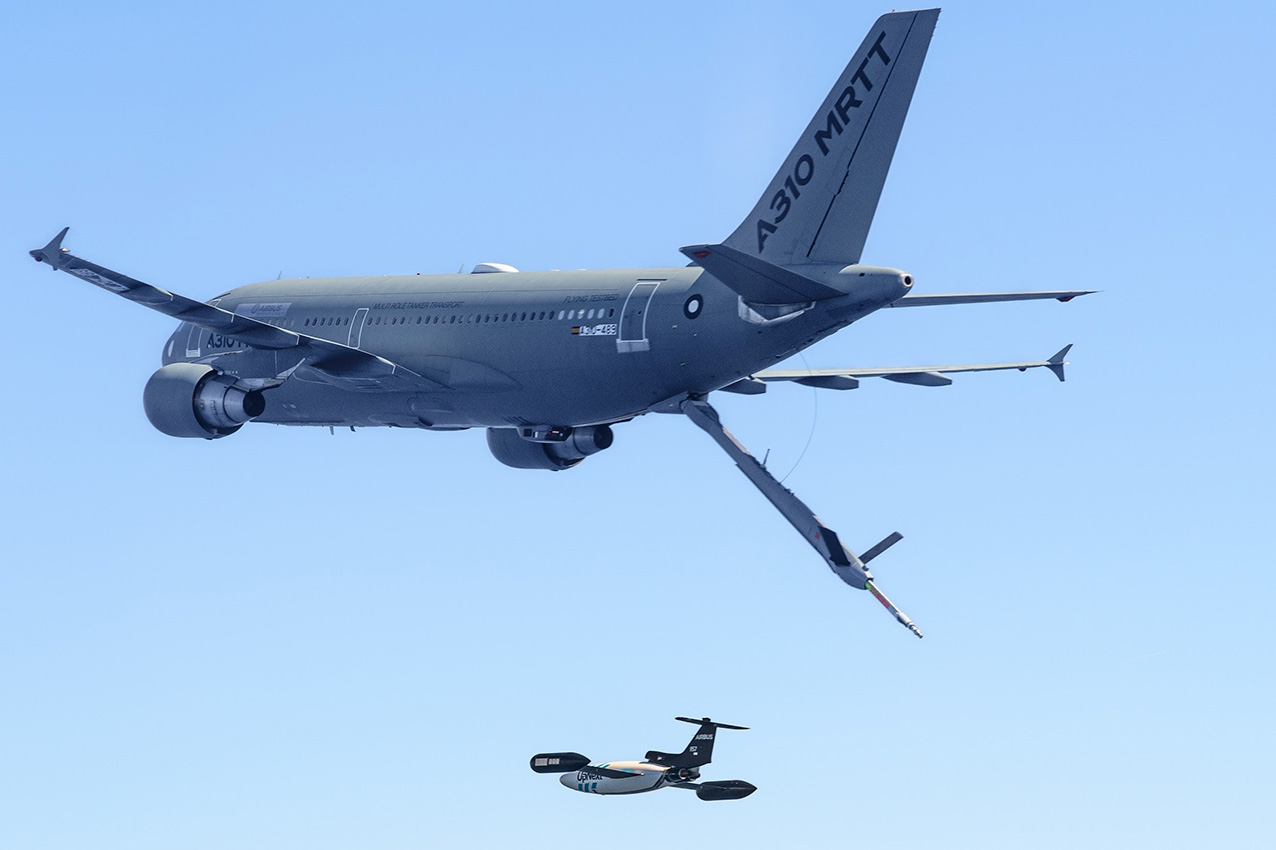
    Huelva, 28 March 2023. Airbus Defence and Space and the company’s wholly-owned subsidiary, Airbus UpNext, have achieved in-flight autonomous guidance and control of a drone using an A310 MRTT.

    In a first step towards Autonomous Formation Flight and Autonomous Air-to-Air refuelling (A4R), the technologies demonstrate a significant breakthrough for future aerial operations involving manned and unmanned assets.

    These cutting-edge, ‘Made in Europe’ solutions could reduce crew fatigue and the potential for human error, as well as minimising crew-training costs and providing more effective operations.

    “The success of this first flight-test campaign paves the way for developing autonomous and unmanned air-to-air refuelling technologies,” said Jean Brice Dumont, Head of Military Air Systems at Airbus Defence and Space. “Even though we are at an early stage, we have achieved this within just one year and are on the right track for manned-unmanned teaming and future air force operations where fighters and mission aircraft will fly jointly with drone swarms.”

    Known as Auto’Mate, the technologies were integrated on an A310 MRTT flying testbed, which took off from Getafe, Spain, on 21 March, and on several DT-25 target drones, acting as receiver aircraft and flying from Arenosillo Test Centre (CEDEA) at Huelva, Spain.

    Over the waters of the Gulf of Cadiz, the control of the drone transitioned from a ground station to the A310 MRTT, autonomously guiding the DT-25 to the in-flight refuelling position.

    During almost six hours of flight test, the four successively launched receivers were sequentially controlled and commanded thanks to artificial intelligence and cooperative control algorithms, without human interaction. The different receivers were controlled and guided until a minimum distance of 150 feet (around 45 metres) from the A310 MRTT.

    Auto’Mate Demonstrator technology focuses on three pillars:

    • Accurate Relative Navigation to precisely ascertain the relative position, speed and attitudes between the tanker and the receiver;
    • Intra-Flight Communication between platforms to allow information exchange among the different assets, increasing the autonomy of the system of systems;
    • Cooperative Control Algorithms to provide guidance, coordination, consensus and collision-avoidance functionalities to the tanker and the receiver/s.

    These pioneering technologies, developed by a European team from Spain, Germany and France, will continue to increase the capability gap among competitors, as well as being re-used in key technological projects, such as the Future Combat Air System (FCAS).

    A second campaign is expected towards the end of 2023, exploring the use of navigation sensors based on artificial intelligence and enhanced algorithms for autonomous formation flight. In addition, there will also be two simulated drones flying in the vicinity of the A310 MRTT to demonstrate multi-receiver autonomous operations and collision-avoidance algorithms.