Category: Featured

Featured posts

  • MiG 21 vs Tejas: India’s Fighter Jet Evolution

    MiG 21 vs Tejas: India’s Fighter Jet Evolution

    MiG 21 vs Tejas: The story of the Indian Air Force is incomplete without the MiG-21 and the HAL Tejas. While one symbolizes India’s dependence on foreign technology during the Cold War era, the other reflects the nation’s progress toward self-reliance in defense manufacturing. Comparing the MiG-21 with the Tejas is not just about aircraft specifications—it’s about contrasting two generations of India’s air power.

    In this blog, we will delve deeper into the specifications, combat histories, and the ongoing debates surrounding the MiG-21 and Tejas. Stay tuned as we unravel the tale of these aerial warriors and explore the intricate dance of past and future in the skies.

    In News

    The prolonged existence of the aging MiG fleet within the Indian Air Force has been a persistent concern spanning several decades. This issue has ignited discussions regarding the safety of these fighter jets, coupled with inquiries into the reasons behind their continued operation despite being associated with tragic incidents that claimed the lives of numerous Air Force pilots.

    To address these challenges and modernize its air defenses, the Indian Air Force has formulated plans to retire the aging MiG fleet, which includes the MiG-21, MiG-23, and MiG-27. In a strategic move, the Air Force intends to replace these aging aircraft by procuring 100 new Light Combat Aircraft (LCA) Tejas Mark-1A fighter jets from Hindustan Aeronautics Limited (HAL). This ambitious initiative signifies a significant step towards rejuvenating and bolstering the country’s air capabilities.

    The MiG-21: Cold War Relic or Timeless Warrior?

    The Mikoyan-Gurevich MiG-21, a product of the Soviet Union’s aerospace ingenuity, stands as a living testament to the tumultuous era of the Cold War. Nicknamed the “Fishbed,” this supersonic interceptor played a pivotal role in countless conflicts and aerial skirmishes, earning a reputation for its agility and speed. With its delta wing design and sleek aerodynamics, the MiG-21 became a symbol of Soviet air power during the latter half of the 20th century.

    Tejas: India’s Leap into the Future

    In stark contrast to the MiG-21’s Cold War roots, the Tejas, meaning “Radiant” in Sanskrit, represents India’s foray into modern, indigenous fighter aircraft development. Conceived and developed by the Aeronautical Development Agency (ADA) and manufactured by Hindustan Aeronautics Limited (HAL), the Tejas is a result of years of research, innovation, and a commitment to reducing dependency on foreign military hardware.

    Clash of Design Philosophies

    As these two aircraft prepare to share the same airspace, their differences in design philosophies become glaringly apparent. The MiG-21, with its tried-and-tested Soviet engineering, boasts a simplicity that emphasizes raw performance. On the other hand, the Tejas showcases a more intricate design, incorporating composite materials, fly-by-wire technology, and modern avionics. The clash between these design philosophies underscores the evolution of aerial combat technology over the decades.

    Operational Realities: MiG-21’s Legacy vs Tejas’ Ascent

    Examining the operational histories of these aircraft sheds light on the shifting dynamics of air forces around the world. The MiG-21, having served in over sixty countries, played a crucial role in numerous conflicts, from the Vietnam War to the Indo-Pakistani wars. Meanwhile, the Tejas, in its nascent years, has already begun to assert its capabilities as the backbone of the Indian Air Force, marking a shift towards self-reliance and technological advancement.

    MiG 21 vs Tejas Detailed Comparison

    The MiG-21, a veteran of Cold War skies, faces off against the Tejas, a symbol of India’s commitment to indigenous technological prowess. Let’s delve into a detailed comparison of these two iconic aircraft.

    Design and Aerodynamics:

    MiG-21:

    • The MiG-21, designed in the 1950s, features a delta wing design for high-speed performance and agility.
    • Known for its simplicity, the MiG-21 relies on aerodynamic efficiency and a powerful engine for maneuverability.
    • The aircraft has a distinctive nose-up attitude on the ground due to its delta wing configuration.

    Tejas:

    • The Tejas, a more recent design, incorporates a delta wing with leading-edge extensions for improved control and stability.
    • Its design includes composite materials, contributing to reduced radar cross-section and increased stealth capabilities.
    • The Tejas features a modern fly-by-wire control system, enhancing its agility and responsiveness.

    Avionics and Technology:

    MiG-21:

    • The MiG-21, a product of its era, features basic avionics with limited electronic warfare and radar capabilities.
    • Its radar systems are comparatively rudimentary, reflecting the technology available during its development.

    Tejas:

    • The Tejas is equipped with state-of-the-art avionics, including an advanced multi-mode radar, electronic warfare suite, and modern communication systems.
    • A glass cockpit with a hands-on throttle and stick (HOTAS) system enhances pilot situational awareness and control.

    Speed and Performance:

    MiG-21:

    • Renowned for its impressive speed, the MiG-21 can attain speeds exceeding Mach 2.
    • Its high thrust-to-weight ratio contributes to its exceptional climb rate and interception capabilities.

    Tejas:

    • While the Tejas may not match the MiG-21 in absolute top speed, it compensates with advanced avionics, agility, and maneuverability.
    • The Tejas is designed for both air-to-air and air-to-ground missions, showcasing versatility in its performance.

    Armament and Mission Capabilities:

    MiG-21:

    • Traditionally configured for air-to-air combat, the MiG-21 has been equipped with a variety of missiles, cannons, and bombs.
    • Its role has evolved over the years, adapting to changing military requirements.

    Tejas:

    • The Tejas is designed as a multi-role fighter, capable of carrying a diverse range of weapons, including beyond-visual-range missiles, precision-guided munitions, and air-to-surface missiles.
    • Its mission capabilities encompass air superiority, ground attack, and reconnaissance.

    Operational History:

    MiG-21:

    • The MiG-21 has an extensive operational history, having served in numerous conflicts worldwide.
    • While it earned a reputation for its agility and speed, it also faced challenges, particularly in the context of evolving aerial warfare technologies.

    Tejas:

    • The Tejas is in the early stages of its operational history but has already demonstrated its capabilities in various training exercises.
    • Its induction into the Indian Air Force marks a significant step towards reducing dependency on foreign-made fighter aircraft.

    MiG 21 vs Tejas Data Table

    Here’s a simplified data table comparing some key specifications of the MiG-21 and Tejas:

    Parameter MiG-21 Tejas
    Origin Soviet Union India
    First Flight 1955 2001
    Role Interceptor, Fighter-Bomber Multirole Fighter
    Wingspan 7.15 m (23 ft 5 in) 8.2 m (26 ft 11 in)
    Length 14.7 m (48 ft 3 in) 13.2 m (43 ft 4 in)
    Height 4.1 m (13 ft 7 in) 4.4 m (14 ft 9 in)
    Maximum Speed Mach 2.1 Mach 1.8
    Range 1,215 km (755 mi) 3,000 km (1,864 mi)
    Service Ceiling 17,000 m (55,775 ft) 16,500 m (54,130 ft)
    Engine Tumansky R-25 General Electric F404-GE-IN20
    Thrust 40.21 kN (9,040 lbf) 53.22 kN (11,982 lbf)
    Crew 1 1
    Avionics Basic Advanced Multi-Mode Radar, HOTAS
    Weapons Missiles, Bombs, Cannons Beyond-Visual-Range Missiles, Precision-Guided Munitions
    First Operational Year 1959 2016 (Initial Operational Clearance)

    Please note that the specifications provided are general figures and might vary based on specific variants and upgrades.

    The MiG-21, once the pride of the Indian Air Force, served as a reliable workhorse for decades despite its limitations. It represents an era when India relied heavily on imports to secure its skies. On the other hand, the HAL Tejas marks a new chapter—light, agile, and equipped with modern avionics, it reflects India’s capability to design and build advanced fighter jets indigenously.

    Conclusion:

    As the MiG-21 and Tejas share the same airspace, it’s not merely a battle of two aircraft but a clash of eras and philosophies. The MiG-21, with its storied past, faces a modern contender in the Tejas, representing the present and future of India’s aerospace industry. This detailed comparison serves as a prelude to unraveling the intricacies of these aerial warriors in the upcoming segments of our exploration. Stay tuned for a deeper dive into their specifications, combat histories, and the ongoing debates within the aviation community.

  • Israel Vs Iran: Comparison Of Armies, Air Forces, And Nuclear Capabilities Of Middle East’s Strongest Nations

    Israel Vs Iran: Comparison Of Armies, Air Forces, And Nuclear Capabilities Of Middle East’s Strongest Nations

    Israel vs Iran Military Power: In the tumultuous landscape of the Middle East, two nations stand out for their military might and strategic importance: Israel and Iran. Both countries boast formidable armies, advanced air forces, and, in the case of Iran, a controversial nuclear program. As regional powers, they play significant roles in shaping the geopolitical dynamics of the region.

    In this blog, we delve into the military capabilities of Israel and Iran, examining the factors that contribute to their power, the technological advancements that define their armed forces, and the strategic considerations that underpin their defense postures. As both countries navigate a delicate equilibrium of deterrence and preparedness, understanding the nuances of their military capabilities becomes imperative for comprehending the broader regional dynamics.

    Israel vs Iran Military Power

    Defense Budget

    Israel’s Defense Budget:

    Defense Budget (2023): 24341.00 USD Million

    Israel, surrounded by a challenging neighborhood and having faced multiple conflicts since its establishment, has consistently invested a significant portion of its GDP in defense. The Israeli Defense Forces (IDF) are renowned for their technological advancements, intelligence capabilities, and agility. Understanding Israel’s defense budget involves delving into its commitment to maintaining qualitative military superiority, innovation in defense technologies, and the capability to swiftly respond to emerging threats.

    Iran’s Defense Budget:

    Defense Budget (2023): 24.6 USD billion

    On the other side of the spectrum, Iran, a regional power with aspirations for influence beyond its borders, allocates substantial resources to its military. The Islamic Republic sees its military strength as a deterrent and a tool for safeguarding its national interests. The examination of Iran’s defense budget involves considering its paramilitary forces, ballistic missile program, and regional proxy networks, shedding light on the multifaceted nature of its military strategy.

    Army Comparison

    Here’s a data table comparing the armies of Israel and Iran based on the information provided:

    Category Israel (IL) Iran (IR)
    Active Personnel 169,500 610,000
    Reserve Personnel 465,000 350,000
    Available for Military Service 1,797,960 23,619,215
    Tanks 1,650 2,842
    Armoured Fighting Vehicles 6,135 3,555
    Total Artillery 1,000 4,873
    Self-Propelled Artillery 650 1,030
    Rocket Artillery 48 1,755

    This table offers a comparison of key military statistics for the armies of Israel and Iran.

    Air Power Comparison

    Here’s a data table comparing the air forces of Israel and Iran:

    Category Israel (IL) Iran (IR)
    Total Aircraft 618 973
    Fighter Aircraft 41 112
    Multirole Aircraft 230 75
    Attack Aircraft 0 23
    Helicopters 128 519
    UCAV (Combat Drones) 15 83

    This table provides an overview of key aircraft categories in the air forces of Israel and Iran.

    Naval Power Comparison

    Here’s a data table summarizing the naval power of Israel and Iran based on the information provided:

    Category Israel (IL) Iran (IR)
    Total Naval Assets 74 272
    Aircraft Carriers 0 0
    Destroyers 0 0
    Frigates 0 6
    Corvettes 7 3
    Submarines 6 19

    This table provides a comparative overview of key naval assets for Israel and Iran.

    Military Service

    Israel:

    • Compulsory military service in Israel begins at 18 years of age for Jews and Druzes.
    • Voluntary military service starts at 17 years of age for Christians, Muslims, and Circassians.
    • Both genders are required to serve in the military.
    • Enlisted men serve for 36 months, enlisted women for 21 months, and officers for 48 months.
    • Pilots commit to 9 years of service.
    • Reserve obligation extends to age 41-51 for men and up to age 24 for women.

    Iran:

    • Compulsory military service in Iran starts at 18 years of age.
    • Volunteers can join at 16 years of age.
    • Law Enforcement Forces enlist at 17 years of age.
    • Basij Forces (Popular Mobilization Army) allow enrollment at 15 years of age.
    • Conscript military service obligation lasts for 18 months.
    • Women are exempt from mandatory military service.

    Israel and Iran War

    The relationship between Iran and Israel has undergone distinct phases:

    Period of Initial Hostility: 1947-1953

    • Iran was an early opponent of the establishment of Israel, voting against its formation in 1947.
    • In 1949, Iran abstained from voting for Israel’s admission to the UN.
    • Despite these initial stances, Iran recognized Israeli sovereignty in 1950, making it the second Muslim-majority nation to do so.

    Period of Cold Peace: 1953-1979

    • After the ascent of the pro-western Mohammad Reza Pahlavi to power as the Shah of Iran in 1953, there was a phase of relative peace in Israel-Iran relations.

    Period After Iranian Revolution: 1979-1990s

    • The Iranian Revolution in 1979 led to the establishment of a theocratic government in Iran.
    • The Supreme Leader, Ayatollah Khomeini, declared Israel as ‘the enemy of Islam.’
    • Diplomatic ties were severed, and embassies were closed down as Iran refused to recognize the legitimacy of Israel.

    These phases reflect the complex and often tumultuous history of relations between Iran and Israel, shaped by geopolitical shifts and ideological changes in both countries.

    Conclusion 

    Comparing the military power of Israel and Iran involves considering various aspects beyond just numbers. Here are some key takeaways:

    Israel’s Strengths:

    • Israel has a highly advanced and technologically sophisticated military, with a focus on quality over quantity.
    • The Israel Defense Forces (IDF) benefit from robust training and coordination.
    • Israel’s air force is well-equipped and includes modern fighter aircraft.
    • The country possesses a substantial number of submarines, which can play a strategic role in maritime security.

    Iran’s Strengths:

    • Iran maintains a large standing military and a significant pool of reserve personnel.
    • Iran has a diverse arsenal of ballistic missiles and rocket artillery.
    • Its air defense capabilities have been developed to counter potential threats.
    • Iran’s military strategy includes asymmetric warfare and a focus on regional influence through proxy groups.

    Key Considerations:

    • Israel’s military is tailored for defense and regional deterrence, with a strong emphasis on rapid response.
    • Iran’s military strategy includes regional influence and supporting allies in conflicts such as Syria and Yemen.
    • Israel has a qualitative edge in technology and training, but Iran has greater numerical strength.
    • The balance of power also depends on regional dynamics, alliances, and diplomatic relations.

    It’s important to note that military power is just one aspect of a country’s overall strength. Both Israel and Iran have unique geopolitical situations, regional interests, and alliances that influence their military postures. Additionally, the ability to effectively project power and the willingness to engage in conflicts are critical factors in assessing military capabilities.

  • Any Act Of Terror Will Be Considered An Act of War: India’s Warning To Pakistan

    Any Act Of Terror Will Be Considered An Act of War: India’s Warning To Pakistan

    New Delhi, May 10, 2025 — In a bold and unprecedented statement, the Indian government has declared that any future terrorist attack on its soil will be considered an “act of war,” promising a swift and decisive response. The announcement, made by the Ministry of Defence, underscores India’s hardening stance against cross-border terrorism and signals a potential shift in its national security policy.

    Speaking at a press conference, Defence Minister Rajnath Singh stated, “India has always exercised restraint in the face of provocation, but our patience must not be mistaken for weakness. Any further terror attack orchestrated or supported from beyond our borders will be treated as an act of war, and India will respond accordingly with the full might of its armed forces.”

    The statement comes amid heightened tensions in the region, following a series of intelligence reports indicating potential threats from terrorist groups allegedly backed by hostile neighboring states. While the government did not name any specific country, analysts suggest the warning is primarily directed at Pakistan, given the history of cross-border militancy in Jammu and Kashmir.

    The Ministry of External Affairs further clarified that India would reserve the right to take preemptive or retaliatory actions, including military strikes, to neutralize threats. “We will not hesitate to act in self-defense to protect our citizens and sovereignty,” a ministry spokesperson said.

    International reactions have been mixed. The United States and several European nations expressed support for India’s right to defend itself but urged restraint to avoid escalation in an already volatile region. Meanwhile, Pakistan’s Foreign Ministry denounced the statement as “provocative” and called for dialogue to address mutual concerns.

    Security experts view the announcement as a significant escalation in India’s counterterrorism strategy. “This is a clear message that India is prepared to raise the costs for any state or non-state actor involved in terrorism,” said Dr. Ankit Sharma, a defense analyst at the Institute for Strategic Studies in New Delhi. “It also puts pressure on the international community to act against terror financing and safe havens.”

    The Indian armed forces have been placed on high alert, with increased surveillance along the Line of Control (LoC) and international borders. The government has also vowed to strengthen its intelligence-sharing mechanisms with allied nations to preempt potential attacks.

  • Pakistan PM Sharif Slams Indian Strikes as ‘Cowardly,’ Signals Nuclear Readiness with NCA Meeting

    Pakistan PM Sharif Slams Indian Strikes as ‘Cowardly,’ Signals Nuclear Readiness with NCA Meeting

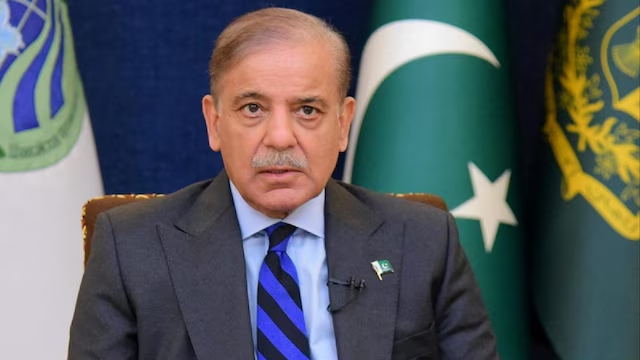
    Pakistani Prime Minister Shehbaz Sharif condemned India’s recent air strikes on Pakistani air bases as “cowardly and unprovoked,” vowing a robust response as he convened an emergency meeting of the National Command Authority (NCA), the body overseeing Pakistan’s nuclear arsenal. The provocative rhetoric and nuclear posturing have heightened global fears of a potential nuclear escalation between the two South Asian rivals, following intense military exchanges sparked by a deadly attack in India-administered Kashmir on April 22.

    Speaking at a press conference in Islamabad, Sharif accused India of targeting civilian infrastructure and killing dozens in Pakistan-administered Kashmir and Punjab province. “These are not the actions of a responsible state but a cowardly attempt to destabilize Pakistan,” he declared, referencing India’s Operation Sindoor, which reportedly destroyed key Pakistani Air Force facilities, including Nur Khan Airbase in Rawalpindi and Rafiqi Air Base in Shorkot. India claims the strikes targeted “terrorist camps” linked to groups like Jaish-e-Mohammed, a charge Pakistan vehemently denies.

    The NCA meeting, attended by top civilian and military leaders, including Chief of Army Staff General Asim Munir, was described by officials as a strategic review of Pakistan’s defense posture. While no official statement detailed the agenda, Sharif’s remarks about “all necessary measures” to protect national sovereignty have been widely interpreted as a signal of nuclear readiness. Posts on X amplified the alarm, with users calling the NCA’s involvement “a chilling escalation” and others accusing Sharif of “playing a dangerous game” to rally domestic support.

    Pakistan’s military, under Operation Bunyan-un-Marsoos, launched retaliatory strikes on Saturday, targeting Indian military sites, including a missile storage facility in northern India, according to the Inter-Services Public Relations (ISPR). The ISPR also claimed to have downed Indian drones and repelled missile attacks, though India insists its strikes caused significant damage to Pakistan’s air defenses. Independent verification remains limited, with conflicting reports fueling propaganda on both sides.

    International reactions have been swift and alarmed. The G7 nations, in a statement issued Saturday, urged both countries to cease hostilities and pursue dialogue, warning of a “nuclear flashpoint.” U.S. Secretary of State Marco Rubio pressed Sharif in a call to avoid further escalation, but sources suggest Pakistan views Western mediation with skepticism, citing perceived bias toward India. China, a key Pakistani ally, called for “calm and restraint” but stopped short of condemning India’s actions.

    Sharif’s remarks also included a nod to domestic unity, with the Prime Minister appealing to Pakistanis to stand firm against “external aggression.” Former Prime Minister Nawaz Sharif, his brother, reportedly advised a diplomatic approach behind closed doors, according to The Express Tribune, but public sentiment on X shows strong support for a hardline stance, with hashtags like #PakistanStrikesBack trending.

    The conflict’s roots lie in the April 22 Pahalgam attack, which killed 26 civilians and prompted India to blame Pakistan-based militants. Since then, tit-for-tat strikes have displaced thousands along the Line of Control, with Pakistan reporting blackouts in border areas and India alleging civilian deaths from Pakistani shelling in Poonch. As commercial airlines avoid regional airspace and the UN scrambles to convene a Security Council session, the international community faces mounting pressure to avert a broader conflict.

    Analysts warn that Sharif’s nuclear signaling, coupled with India’s aggressive military posture, risks a catastrophic miscalculation. “The NCA meeting is a clear message: Pakistan is prepared to escalate if pushed,” said a security expert in Islamabad. With both nations entrenched and global diplomacy struggling to gain traction, the specter of nuclear conflict looms larger than ever.

  • G7 Urges Immediate Restraint as India-Pakistan Conflict Risks Nuclear Flashpoint

    G7 Urges Immediate Restraint as India-Pakistan Conflict Risks Nuclear Flashpoint

    The Group of Seven (G7) nations issued an urgent call for restraint on Saturday, warning that the escalating conflict between India and Pakistan risks spiraling into a nuclear catastrophe. The statement, released after an emergency virtual meeting of G7 foreign ministers, comes as both nuclear-armed nations intensify military operations, with India’s Air Force striking Pakistani air bases and Pakistan convening its National Command Authority (NCA) to discuss nuclear readiness.

    G7 table flags, 3d render. Flags of Group of Seven around podium, countries: Canada, France, Germany, Italy, Japan, the United Kingdom, USA.

    The G7, comprising the United States, Canada, France, Germany, Italy, Japan, and the United Kingdom, expressed “grave concern” over the rapidly deteriorating situation, which has seen heavy exchanges of missile and drone strikes since a deadly April 22 attack in India-administered Kashmir killed 26 civilians. India accuses Pakistan of orchestrating the attack, a charge Islamabad denies, prompting India’s Operation Sindoor, which obliterated key Pakistani air bases, including Nur Khan in Rawalpindi and Rafiqi in Shorkot, according to Indian defense sources. Pakistan retaliated with Operation Bunyan-un-Marsoos, targeting Indian military sites and claiming to have downed Indian jets.

    “We urge India and Pakistan to exercise maximum restraint, cease all military actions, and engage in direct dialogue to prevent a catastrophic escalation,” the G7 statement read. “The risk of miscalculation between two nuclear-armed states threatens not only regional but global stability.” The group called for an immediate ceasefire and offered to facilitate diplomatic talks, though no concrete mediation plan was outlined.

    The G7’s warning follows reports of significant civilian casualties, with Pakistan alleging Indian strikes killed dozens in Pakistan-administered Kashmir, while India claims Pakistani shelling in Jammu and Poonch claimed 15 civilian lives. Posts on X reflect global alarm, with users describing the situation as “a nuclear powder keg” and criticizing the lack of decisive international intervention. Others noted Pakistan’s NCA meeting, chaired by Prime Minister Shehbaz Sharif, as a signal of heightened nuclear alertness, with some calling it “terrifying posturing.”

    U.S. Secretary of State Marco Rubio, representing the G7’s lead voice, held separate calls with Indian Foreign Secretary Vikram Misri and Pakistani Foreign Minister Ishaq Dar, pressing both sides to de-escalate. However, U.S. influence appears limited, with sources citing President Donald Trump’s reported dismissal of the conflict as “not our problem,” according to NPR. France and Germany echoed the G7’s concerns, with French Foreign Minister Jean-Noël Barrot warning that “a single misstep could unleash unimaginable consequences.”

    India’s Ministry of External Affairs responded cautiously, asserting that its strikes targeted “terrorist infrastructure” and were a direct response to Pakistan’s alleged support for groups like Jaish-e-Mohammed. Pakistan’s Foreign Ministry, in turn, condemned India’s “unprovoked aggression” and defended its retaliatory strikes as “self-defense,” while denying civilian targeting.

    The United Nations, in a parallel statement, called for an emergency session of the Security Council to address the crisis, with Secretary-General António Guterres urging both nations to respect international humanitarian law. Meanwhile, commercial airlines have rerouted flights to avoid Pakistani and Indian airspace, and border regions in Kashmir report mass evacuations amid relentless artillery fire.

    Analysts warn that the G7’s call, while significant, may fall short without robust mediation. “The G7’s words are strong, but both India and Pakistan are entrenched,” said a South Asia expert at the Brookings Institution. “Without a clear de-escalation mechanism, the nuclear risk grows by the hour.” As global attention remains riveted on the region, the international community faces mounting pressure to prevent a conflict that could redefine the global security landscape.

  • India Destroys Pakistani Air Bases! COMPLETE DOMINATION BY IAF!

    India Destroys Pakistani Air Bases! COMPLETE DOMINATION BY IAF!

    The Indian Air Force (IAF) has delivered a stunning blow to Pakistan’s military infrastructure, targeting and severely damaging multiple air bases in a meticulously executed operation on Saturday morning. Sources confirm that the IAF’s strikes hit key Pakistani Air Force (PAF) facilities, including Nur Khan Airbase in Rawalpindi, PAF Rafiqi Air Base in Shorkot, Murid Air Base in Chakwal, and drone launchpad sites, significantly disrupting Pakistan’s air defense capabilities. The operation, an extension of India’s “Operation Sindoor,” is being hailed as a demonstration of the IAF’s unmatched dominance in the region.

    The strikes come amid escalating tensions following a terrorist attack on April 22 in India-administered Kashmir, which killed 26 civilians, mostly tourists. India has accused Pakistan of supporting the attack, a charge Islamabad denies. According to Indian defense sources, the IAF deployed advanced Rafale jets, armed with precision-guided SCALP missiles and AASM Hammer glide bombs, to neutralize strategic targets. Posts on X and reports from India Today indicate that India also destroyed Pakistani air defense systems and drone launch facilities, further crippling Pakistan’s ability to respond.

    Pakistan’s military, however, claims that all PAF assets remain safe, with Director General Inter-Services Public Relations (DG ISPR) asserting that Indian missiles failed to cause significant damage. Despite these claims, visuals verified by The Washington Post and other outlets show debris consistent with Indian fighter jets, suggesting Pakistan may have downed some IAF aircraft during earlier engagements on May 7. India has not confirmed these losses, maintaining that its strikes were “focused and measured” to avoid civilian casualties.

    Indian Foreign Secretary Vikram Misri described the operation as a necessary response to Pakistan’s alleged support for terrorist groups like Jaish-e-Mohammed and Lashkar-e-Taiba. “India will not tolerate threats to its sovereignty,” Misri said in a press briefing. The strikes targeted nine locations, including militant camps in Pakistan-administered Kashmir and Punjab province, with no Pakistani military facilities directly hit, according to India’s Ministry of Defense.

    The operation has sparked mixed reactions. On X, Indian users celebrated the IAF’s prowess, with posts declaring “Jai Hind” and praising the strikes as a decisive blow to Pakistan’s military. Others expressed concern over the risk of escalation, noting Pakistan’s retaliatory operation, “Bunyan al-Marsus,” launched on Saturday, which targeted Indian military sites, including a missile storage facility in northern India. International leaders, including the G7 and U.S. Secretary of State Marco Rubio, have urged both nations to exercise restraint and pursue dialogue to prevent a full-scale conflict.

    Analysts warn that the destruction of Pakistani air bases, if confirmed, could shift the regional power balance, with India’s advanced weaponry and strategic planning outmatching Pakistan’s defenses. However, Pakistan’s reported use of Chinese-made J-10 jets to down Indian aircraft earlier in the week suggests a resilient counter-capability. As both nations exchange accusations of drone and missile attacks, the situation remains volatile, with commercial airlines avoiding Pakistani airspace and civilians on both sides bracing for further hostilities.

    The IAF’s operation underscores India’s resolve to counter perceived threats, but the specter of nuclear escalation looms large. As Prime Minister Shehbaz Sharif convenes Pakistan’s National Command Authority to discuss its nuclear arsenal, the world watches anxiously, hoping diplomacy can avert a broader catastrophe.

  • Balochistan Asserts Distinct Identity with Flag, Anthem, and Roadmap, Says Mir Yar Baloch

    Balochistan Asserts Distinct Identity with Flag, Anthem, and Roadmap, Says Mir Yar Baloch

    Quetta, Pakistan – May 8, 2025: Mir Yar Baloch, a prominent voice in the Baloch independence movement, has publicly declared that Balochistan possesses its own flag, anthem, and roadmap, emphasizing a unique identity separate from what he describes as “radical Pakistan.” The statement, widely circulated through posts on X, reflects growing momentum in the Baloch nationalist movement amid escalating tensions in Pakistan’s largest province.

    In a video shared on social media, supporters of the Free Balochistan Movement were seen hoisting the Baloch flag—featuring green and red horizontal bands, a blue triangle, and a white star—while singing the Baloch national anthem, “Ma Chukin Balochaani” (“We Are Sons of Baloch”). Mir Yar Baloch highlighted the anthem as a symbol of pride and unity for the Baloch people, who seek independence from Pakistan. He urged the international community to recognize Balochistan’s sovereignty and establish diplomatic missions to support the movement.

    “Balochistan is not Pakistan. We have our own culture, language, and vision for a free and democratic future,” Mir Yar Baloch stated, referencing the Balochistan Liberation Charter promoted by Hyrbyair Marri, leader of the Free Balochistan Movement. The charter outlines a secular struggle for independence, accusing Pakistan and Iran of cultural and ethnic suppression of the Baloch people.

    The Baloch nationalist movement traces its roots to the 1948 accession of the Khanate of Kalat to Pakistan, which many Baloch claim was coerced. Since then, five waves of insurgency have marked the region, with the current phase, ongoing since 2003, driven by groups like the Baloch Liberation Army (BLA). The BLA, designated a terrorist organization by Pakistan and several Western countries, has intensified attacks, including a recent train hijacking in March 2025, to demand autonomy or independence.

    Balochistan, spanning 44% of Pakistan’s landmass, is rich in natural resources but remains its most underdeveloped province. Nationalists argue that the central government exploits the region’s gas, gold, and copper while neglecting local development. The China-Pakistan Economic Corridor (CPEC), passing through Balochistan, has further fueled resentment, with Baloch activists claiming it threatens demographic changes and marginalizes locals.

    Mir Yar Baloch’s call for recognition has sparked debate. On X, supporters echoed his message, with some urging India and other nations to pass resolutions recognizing Balochistan’s independence. Others criticized Pakistan’s military response to the insurgency, alleging human rights abuses and forced disappearances. However, a 2009 Pew Research Center survey indicated that 58% of Balochistan residents identified as Pakistani, with only 37% favoring independence in a 2012 Gallup poll, suggesting divided sentiments.

    Pakistan’s government has dismissed the separatist narrative, emphasizing Balochistan’s integration into the federation. The provincial flag, featuring a camel and mountains in Pakistan’s national colors, symbolizes its ties to the state. Islamabad has accused foreign powers, including India, of funding groups like the BLA, a claim India denies.

    As Balochistan grapples with insurgency and economic neglect, Mir Yar Baloch’s statements underscore a deepening divide. Whether the international community will heed his call remains uncertain, but the Baloch flag and anthem continue to rally a movement that refuses to fade.

  • S-400 vs. HQ-9: A Comparative Analysis of Advanced Air Defense Systems

    S-400 vs. HQ-9: A Comparative Analysis of Advanced Air Defense Systems

    S-400 vs. HQ-9: The S-400 Triumf (Russia) and HQ-9 (China) are among the most advanced long-range surface-to-air missile (SAM) systems in the world, designed to counter a wide array of aerial threats, including aircraft, drones, cruise missiles, and ballistic missiles. Deployed by India and Pakistan, respectively, these systems are critical to regional air defense strategies, particularly in the context of South Asian security dynamics. Below is a detailed comparison of their technical specifications, capabilities, and operational effectiveness, drawing on available data and critical analysis.

    S-400 vs. HQ-9 Air Defense Systems

    Overview

    S-400 Triumf (Russia):

    • Developed by Almaz-Antey, the S-400 is an advanced evolution of the S-300 series, entering service in 2007. It is renowned for its long-range engagement, multi-target tracking, and versatility against diverse threats, including stealth aircraft and ballistic missiles. India acquired the S-400 in a $5.43 billion deal in 2018, with deliveries starting in 2021.
    • NATO designation: SA-21 Growler.

    HQ-9 (China):

    • Developed by China Precision Machinery Import-Export Corporation (CPMIEC), the HQ-9 is a long-range SAM system with roots in Russian S-300 technology, enhanced with American and Israeli influences. Pakistan inducted the HQ-9/P variant in October 2021 to bolster its air defense against Indian air assets.
    • NATO designation: CH-SA-9 (HQ-9); CH-SA-21 (HQ-9B).

    Technical Specifications

    Feature S-400 Triumf HQ-9 (and Variants)
    Range Up to 400 km (40N6 missile); 250 km (48N6E3); 120 km (9M96E2); 40 km (9M96E). 125 km (HQ-9/P); 200–260 km (HQ-9B); 25 km against cruise missiles.
    Altitude Up to 30 km (98,000 ft). Up to 27 km (HQ-9/P); 50 km (HQ-9B, claimed).
    Speed Mach 14 (missiles). Mach 4.2 (HQ-9/P); Mach 14 (HQ-9B, claimed).
    Target Tracking Tracks 100–300 targets simultaneously. Tracks up to 100 targets.
    Simultaneous Engagements Engages up to 36 targets. Engages 8–10 targets.
    Radar 91N6E (600 km detection range), 92N6E multi-functional radar (340 km), AESA suite. H-200 phased array (HQ-9/P); HT-233 (FD-2000); less advanced than AESA.
    Missile Types 40N6E (400 km), 48N6E3 (250 km), 9M96E2 (120 km), 9M96E (40 km). HQ-9/P (SARH), HQ-9B (dual SARH/passive IR seeker).
    Guidance Active/passive radar homing, resistant to jamming. Track-via-missile (TVM), semi-active radar homing, passive IR (HQ-9B).
    Weight Varies by missile (e.g., 1,800 kg for 48N6E3). ~2,000 kg (HQ-9).
    Mobility Highly mobile; 5-minute setup time. Mobile; rail/air transportable, but setup time less documented.
    Anti-Ballistic Capability Yes, counters short- and medium-range ballistic missiles. Limited; HQ-19 variant for ABM, not widely deployed.

    Detailed Comparison

    Range and Engagement Envelope

    • S-400: The S-400’s standout feature is its 400 km range with the 40N6 missile, enabling it to engage targets deep within enemy airspace (e.g., from Indian borders to Lahore or Islamabad). Its layered missile suite (40 km to 400 km) provides flexibility against diverse threats, from low-flying drones to high-altitude aircraft. The 600 km radar detection range allows early warning and extended situational awareness.
    • HQ-9: The HQ-9/P, used by Pakistan, has a 125 km range, while the HQ-9B extends to 260 km. This is significantly shorter than the S-400’s maximum range, limiting its ability to engage distant targets. The HQ-9’s 25 km range against cruise missiles is notable but less effective against high-speed threats like India’s BrahMos.
    • Edge: S-400, due to its superior range and layered missile options.

    Target Tracking and Engagement

    • S-400: Can track 100–300 targets and engage 36 simultaneously, making it ideal for countering saturation or multi-axis attacks. Its AESA radars (e.g., 91N6E, 92N6E) offer 360-degree coverage, resistance to jamming, and stealth detection capabilities.
    • HQ-9: Tracks up to 100 targets but engages only 8–10 at once, a critical limitation in high-intensity scenarios. Its H-200 phased array radar is less advanced than the S-400’s AESA suite, and its performance against stealth or supersonic threats (e.g., BrahMos) is questionable, as evidenced by its failure to intercept a stray BrahMos missile in 2022.
    • Edge: S-400, for its higher engagement capacity and superior radar technology.

    Radar and Guidance

    • S-400: Employs a multi-AESA radar suite, including the 91N6E (600 km detection) and 92N6E (340 km tracking), with advanced electronic countermeasures (ECM) resistance. Its active and passive guidance systems enhance accuracy against jamming and stealth targets.
    • HQ-9: Uses the H-200 phased array radar (HQ-9/P) or HT-233 (FD-2000 export variant), which is less sophisticated than AESA. The HQ-9B’s dual semi-active radar homing (SARH) and passive infrared seeker improve terminal guidance, but the system remains vulnerable to ECM and anti-radiation missiles.
    • Edge: S-400, due to its advanced AESA radars and ECM resistance.

    Mobility and Deployment

    • S-400: Highly mobile, with a 5-minute setup time, allowing rapid redeployment to evade detection. Its integration with other systems (e.g., S-300, Tor-M1) enhances networked defense. Deployed by India along borders, it covers key regions like Jammu and Kashmir.
    • HQ-9: Mobile and transportable by rail or air, but specific setup times are less documented. Pakistan deploys it around strategic sites like Karachi and Rawalpindi, with coverage extending to parts of Jammu and Kashmir.
    • Edge: S-400, for its proven rapid setup and broader integration.

    Anti-Ballistic Missile (ABM) Capability

    • S-400: Designed to counter short- and medium-range ballistic missiles, with proven effectiveness in tests and limited combat scenarios (e.g., Russia-Ukraine conflict).
    • HQ-9: Limited ABM capability; the HQ-19 variant is designed for this role but is not widely deployed. The HQ-9/P and HQ-9B focus primarily on air threats.
    • Edge: S-400, for its established ABM role.

    Combat Experience

    • S-400: Proven in the Russia-Ukraine war, with documented intercepts of aircraft, drones, and missiles. Its real-world performance validates its technical claims, though it has vulnerabilities to saturation attacks and anti-radiation missiles.
    • HQ-9: No confirmed combat experience. Its failure to intercept a BrahMos missile in 2022 and reported vulnerabilities during India’s “Operation Sindoor” in 2025 (per X posts) suggest operational limitations.
    • Edge: S-400, due to proven combat effectiveness.

    Vulnerabilities

    • S-400: Susceptible to anti-radiation missiles, electronic warfare, low-flying threats, and saturation attacks using drones or decoys. Its long-range radars can be targeted, and the 40N6 missile has limited operational data.
    • HQ-9: Vulnerable to ECM, anti-radiation missiles, and high-speed threats like BrahMos. Its shorter range and less advanced radars limit its ability to counter multi-axis or stealth attacks. X posts claim India neutralized an HQ-9 system in Lahore in 2025, though this is unverified.
    • Edge: S-400, as it is less vulnerable overall but not invincible.

    Operational Context: India vs. Pakistan

    • India’s S-400: Deployed along borders, the S-400 gives India a strategic advantage, enabling deep strikes into Pakistani airspace and countering assets like F-16s, JF-17s, and Babur cruise missiles. Its integration with indigenous systems (e.g., Akash, Barak-8) creates a layered defense, critical for a two-front scenario against Pakistan and China.
    • Pakistan’s HQ-9: The HQ-9/P and HQ-9BE bolster Pakistan’s defense against Indian air superiority, targeting aircraft like Rafale and Sukhoi-30 MKI. However, its limited range and engagement capacity restrict it to protecting key sites rather than projecting power. Pakistan’s reliance on Chinese technology and lack of a robust layered defense (compared to India’s) is a disadvantage.
    • Strategic Implications: The S-400’s longer range and superior radar allow India to dominate airspace, forcing Pakistan to adopt cautious tactics. The HQ-9’s shorter range and vulnerabilities to supersonic missiles like BrahMos limit its deterrence value.

    Critical Analysis

    The S-400 outclasses the HQ-9 in most technical and operational metrics, particularly in range, target engagement, radar sophistication, and combat experience. Its AESA radars, layered missile suite, and integration capabilities make it a force multiplier for India. However, claims of its invincibility are overstated; it remains vulnerable to advanced countermeasures, as seen in conflicts like Armenia-Azerbaijan, where air defenses were overwhelmed by drones and electronic warfare.

    The HQ-9, while a capable system, is constrained by its technological roots in the S-300 and less advanced radar systems. Its lack of combat testing and reported failures (e.g., BrahMos incident, alleged neutralization in 2025) raise doubts about its reliability in high-intensity conflicts. Pakistan’s deployment is defensive, focusing on protecting strategic assets rather than challenging India’s air dominance.

    X posts claiming the HQ-9’s destruction by India in 2025 are inconclusive without official confirmation, but they reflect a perception of the S-400’s superiority. Conversely, Chinese claims that the HQ-9B rivals the S-400 are not supported by available data, especially given the S-400’s combat-proven record.

    Conclusion

    The S-400 Triumf is superior to the HQ-9 in range, engagement capacity, radar technology, and operational effectiveness, giving India a significant edge over Pakistan in air defense. While the HQ-9 is a credible system for Pakistan’s defensive needs air defense needs, its limitations in range, radar sophistication, and combat experience make it less competitive against the S-400. However, both systems are vulnerable to modern countermeasures, and their effectiveness depends on integration, operator skill, and the broader tactical environment. In the India-Pakistan context, the S-400’s capabilities provide a strategic advantage, but overconfidence could lead to miscalculations, as no system is invincible.

  • S-400 Triumph Bolsters India’s Defense in India-Pakistan Conflict: A Strategic Game-Changer

    S-400 Triumph Bolsters India’s Defense in India-Pakistan Conflict: A Strategic Game-Changer

    The S-400 Triumf air defense system, named Sudarshan in Indian service, has emerged as a cornerstone of India’s defense strategy in the ongoing tensions with Pakistan, particularly during the conflict escalation reported on May 8, 2025.

    Acquired from Russia in a $5.43 billion deal signed in 2018, the S-400 has significantly enhanced India’s ability to counter aerial threats, including missiles, drones, and fighter jets, in the context of the India-Pakistan conflict. Below is a detailed analysis of how the S-400 has aided India, its technical capabilities, strategic deployment, and limitations in the current scenario.

    Key Contributions of the S-400 in the India-Pakistan Conflict

    • Neutralization of Pakistani Missile and Drone Threats
      During Operation Sindoor on May 7-8, 2025, the S-400 played a pivotal role in intercepting Pakistani missiles and drones targeting 15 Indian cities, including Srinagar, Amritsar, Chandigarh, and Bhuj. The system’s advanced radar and missile suite successfully neutralized incoming threats, preventing damage to critical military infrastructure. Social media reports, including posts on X, highlighted the S-400’s effectiveness, with claims that it “shot down Pakistani missiles” during the operation.
    • Deterrence Against Pakistani Air Force Operations
      The S-400’s 400-kilometer engagement range covers significant portions of Pakistani airspace, including strategic locations like Lahore and Islamabad. Deployed along the Line of Control (LoC) and the Indo-Pakistan border, the system can engage Pakistani aircraft, such as the JF-17 Thunder and F-16, before they reach Indian territory. This deep-strike capability complicates Pakistan’s air operations, forcing their jets to operate cautiously or risk being shot down.
    • Countering Pakistan’s Missile Arsenal
      Pakistan’s missile systems, including the Babur and Ra’ad cruise missiles and the Shaheen ballistic missiles, pose a significant threat. The S-400’s ability to intercept cruise missiles at low altitudes (down to 20 meters) and ballistic missiles traveling at speeds up to Mach 14 provides India with a robust defense. Reports suggest the system’s layered missile coverage (40 km to 400 km range) neutralized Pakistani attempts to overwhelm Indian defenses during the May 8 assault.
    • Protection of Key Assets and Cities
      The S-400’s deployment in Punjab and along the LoC creates a protective umbrella over major Indian cities (e.g., Delhi, Mumbai, Kolkata) and critical infrastructure, such as nuclear command centers, military bases, and economic hubs. This reduces vulnerability to punitive strikes, ensuring India’s strategic assets remain secure. The system’s 600-kilometer radar detection range provides early warning, allowing timely interception of threats.
    • Integration with India’s Air Defense Network
      The S-400 is unified with India’s Integrated Air Command and Control System (IACCS), enabling seamless coordination with indigenous systems like Akash, Barak-8, and Quick Reaction Surface-to-Air Missiles (QRSAM). This multi-layered defense architecture enhances India’s ability to counter diverse threats, from low-flying drones to high-altitude ballistic missiles. The system’s Active Electronically Scanned Array (AESA) radars offer superior tracking and resistance to jamming, outperforming Pakistan’s Chinese-supplied HQ-9 systems.

    Technical Capabilities of the S-400

    The S-400 Triumf, developed by Russia’s Almaz-Antey, is one of the world’s most advanced air defense systems. Its key features include:

    • Radar and Detection: The 91N6E radar detects targets up to 600 km, tracking up to 300 targets simultaneously. It can identify low-observable targets, including drones and stealth aircraft.
    • Missile Variants: The system employs four missile types for layered defense:
      • 40N6E: 400 km range, designed for high-altitude targets like AWACS and ballistic missiles.
      • 48N6DM: 250 km range, effective against fighter jets and cruise missiles.
      • 9M96E2: 120 km range, for medium-range threats.
      • 9M96E: 40 km range, for low-altitude, short-range targets like drones.
    • Engagement Capacity: Can engage up to 80 targets simultaneously, with a reaction time of 5-10 seconds.
    • Mobility: Highly mobile, operational within 5 minutes of deployment, making it difficult for adversaries to target.
    • Electronic Countermeasures: Resists jamming and employs decoys to enhance survivability.

    These capabilities outclass Pakistan’s HQ-9BE (200-260 km range) and LY-80 systems, which rely on less advanced phased-array radars and have limited engagement capacities.

    Strategic Deployment in the Conflict

    India has operationalized three of the five S-400 squadrons procured, with deployments focused on dual fronts: Pakistan and China. In the context of the India-Pakistan conflict:

    • Punjab Sector: The first squadron, deployed in 2021, covers threats from Pakistan, protecting northern cities and military bases.
    • LoC and Western Borders: Additional units along the LoC provide coverage over Jammu, Kashmir, and Gujarat, countering Pakistani air and missile incursions.
    • Operation Sindoor: On May 7-8, 2025, the S-400 was activated to intercept Pakistani missiles and drones, demonstrating its combat readiness. The system’s integration with AWACS and early-warning radars ensured precise targeting.

    The remaining two squadrons, delayed due to the Russia-Ukraine conflict, are expected by August 2026, further strengthening India’s defenses.

    Challenges and Limitations

    While the S-400 is a formidable asset, it has limitations that Pakistan could exploit:

    • Vulnerability to Saturation Attacks: Pakistan could deploy drone swarms or large salvos of missiles to overwhelm the S-400’s 80-target engagement capacity. X posts suggest Pakistan may attempt such tactics to drain India’s missile reserves, as the S-400’s interceptors are costly.
    • Hypersonic Threats: The S-400 has not been fully tested against hypersonic glide vehicles (HGVs) like China’s DF-17, which Pakistan may acquire. These ultra-high-speed, maneuverable threats could challenge the system.
    • Electronic Warfare: Pakistan’s electronic countermeasures, demonstrated in 2019, could disrupt the S-400’s radar. China and Turkey, both S-400 operators, may share insights on its weaknesses with Pakistan.
    • Short-Range Gaps: The S-400 is less effective against very short-range threats like artillery shells or low-flying drones. India relies on complementary systems like Akash and QRSAM to address these gaps.
    • Geopolitical Risks: Continued reliance on Russian systems risks U.S. sanctions under CAATSA, potentially straining India’s access to Western technology.

    Pakistan’s Countermeasures

    Pakistan has developed strategies to mitigate the S-400’s impact:

    • HQ-9BE and FD-2000 Systems: While less advanced, Pakistan’s Chinese-supplied systems can engage Indian aircraft and missiles, though their 260-km range is outmatched by the S-400.
    • Fatah-II Missile: X posts claim Pakistan’s Fatah-II, a guided rocket with a 150-km range, could target S-400 batteries if deployed too forward.
    • Cruise Missiles: Pakistan’s Ra’ad and Babur missiles, with low-altitude flight paths, remain vulnerable but could exploit terrain masking to evade detection.
    • Allied Support: Speculation exists that China could share S-400 data, though Russia’s export versions for China have limited capabilities, reducing the risk.

    Strategic Implications

    The S-400 has shifted the aerial balance in India’s favor, complicating Pakistan’s offensive capabilities and strengthening India’s deterrence. By neutralizing missile and drone threats during Operation Sindoor, the system proved its worth as a force multiplier. Its ability to protect key assets and engage deep into Pakistani airspace limits Islamabad’s strategic options, forcing reliance on asymmetric tactics like terrorism or saturation attacks.

    However, the S-400 is not invincible. Pakistan’s evolving missile technology and potential Chinese support could challenge its dominance. India must continue integrating the S-400 with indigenous systems and invest in counter-hypersonic capabilities to maintain its edge. The system’s high cost (Rs 35,000 crore for five squadrons) also necessitates efficient resource allocation to balance other military modernization efforts.

    Conclusion

    The S-400 Triumf has been a game-changer in the India-Pakistan conflict, providing India with unmatched air defense capabilities. Its role in thwarting Pakistani missile strikes on May 8, 2025, underscores its strategic importance. While vulnerabilities exist, the S-400’s integration with India’s broader defense network ensures a robust shield against aerial threats. As tensions persist, the system will remain a critical asset, deterring aggression and safeguarding India’s sovereignty.

  • Baloch Liberation Army Claims Responsibility for Twin Attacks Killing 14 Pakistani Soldiers in Balochistan

    Baloch Liberation Army Claims Responsibility for Twin Attacks Killing 14 Pakistani Soldiers in Balochistan

    The Baloch Liberation Army (BLA), a separatist group seeking independence for Balochistan, has claimed responsibility for two deadly attacks that killed 14 Pakistani Army personnel in the restive province on Tuesday, May 6. The assaults, which took place in Bolan and Kech districts, have intensified concerns about security in the region amid escalating tensions between Pakistan and India.

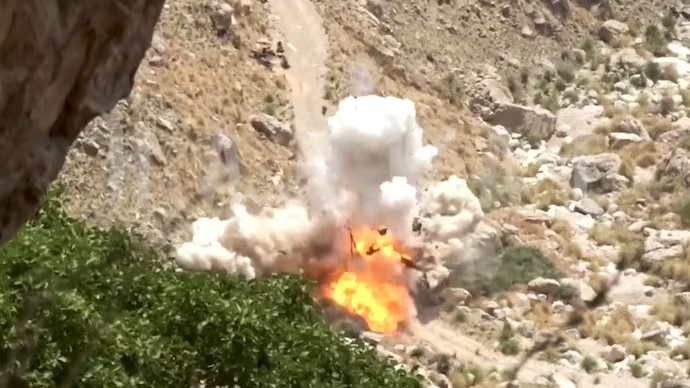
    In the first attack, the BLA’s Special Tactical Operations Squad (STOS) executed a remote-controlled improvised explosive device (IED) attack on a military convoy in the Shorkand area of Mach, Bolan. The blast destroyed the vehicle, killing all 12 soldiers on board, including Special Operations Commander Tariq Imran and Subedar Umar Farooq. The second attack targeted a Bomb Disposal Squad in the Kulag Tigran area of Kech, where a remote-controlled IED detonated at approximately 2:40 PM during a clearance mission, killing two personnel.

    Jeeyand Baloch, the BLA spokesperson, described the attacks as part of their ongoing resistance against the “mercenary” Pakistani military, which they accuse of exploiting Balochistan’s resources and serving foreign interests, particularly Chinese investments under the China-Pakistan Economic Corridor (CPEC). “The attacks on this occupying army by the freedom fighters of Baloch land will continue with greater intensity,” the BLA statement read, rejecting claims that the group operates as a foreign proxy.

    Pakistan’s Inter-Services Public Relations (ISPR) confirmed the attacks, alleging that the BLA acted as an “Indian proxy” without providing evidence. Local officials reported that security forces have launched sanitization operations to eliminate any remaining threats in the area. The attacks come amid heightened regional tensions following India’s “Operation Sindoor,” which neutralized Pakistani missile strikes and targeted terrorist facilities, including those linked to Jaish-e-Mohammed.

    Balochistan Chief Minister Sarfraz Bugti condemned the attacks, vowing that “those who disrupt Balochistan’s peace will face justice.” Prime Minister Shehbaz Sharif echoed the sentiment, promising a robust response to the insurgency. The BLA’s actions highlight long-standing grievances in Balochistan, where separatists accuse the central government of political marginalization, human rights abuses, and economic exploitation of the province’s vast mineral wealth.

    The attacks have drawn attention on social media, with X users like @SouleFacts and @FollowAkshay1 noting the BLA’s precision and the pressure mounting on Pakistan’s military. However, analysts warn that such incidents could further destabilize the region, especially as Pakistan grapples with internal security challenges and external tensions with India.