Category: Aviation

  • Airbus and China aviation industry sign next phase in partnership

    Airbus and China aviation industry sign next phase in partnership

    • General Terms Agreement to allocate 160 aircraft to Chinese airlines
    • Expanding capacity at Tianjin A320 Final Assembly Line to contribute to global rate 75
    • Upscaling the production and use of Sustainable Aviation Fuels

    Beijing, 6th April, 2023. During a French state visit to China, Airbus signed new cooperation agreements with China Aviation industry partners.

    Witnessed by Chinese President Xi Jinping and French President Emmanuel Macron, Airbus CEO, Guillaume Faury signed with the Tianjin Free Trade Zone Investment Company Ltd., and Aviation Industry Corporation of China Ltd., an agreement to expand A320 Family final assembly capacity with a second line at its Tianjin site. The agreement will contribute to Airbus’ overall rate objective of 75 aircraft per month in 2026 throughout its global production network.

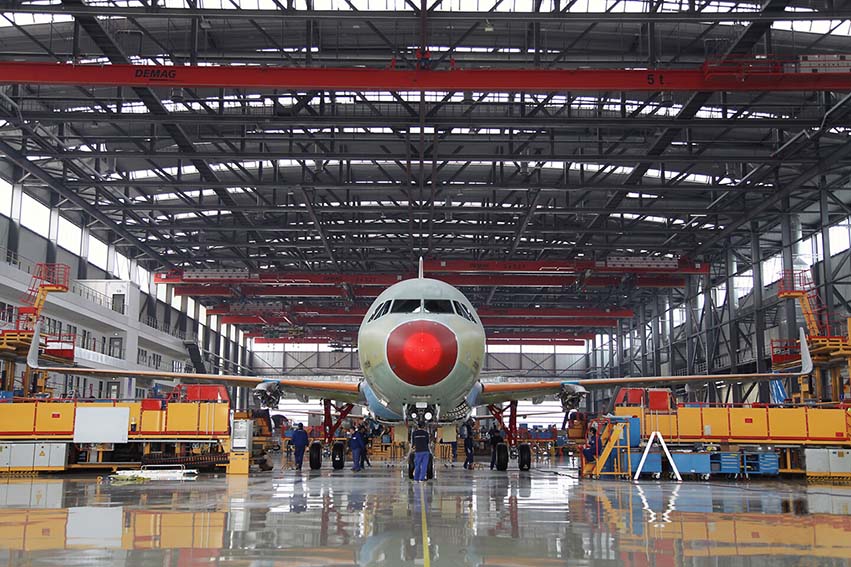
    Currently, Airbus has four A320 Family final assembly sites worldwide: Hamburg (Germany), Toulouse (France), Mobile (USA) and Tianjin (China). The Tianjin Final Assembly Line (FAL Asia) started operation in 2008 and has assembled over 600 A320 Family aircraft to date. In March 2023 the first A321neo aircraft was delivered from the line, marking a new era of enhanced A320 Family production versatility.

    In addition, Airbus also signed General Terms of Agreement (GTA) with the China Aviation Supplies Holding Company (CAS) covering the purchase of 160 Airbus commercial aircraft. The GTA comprises earlier announcements for 150 A320 Family aircraft and for 10 A350-900 widebody aircraft orders, reflecting the strong demand in all market segments by Chinese carriers.

    Over the next 20 years, China’s air traffic is forecast to grow at 5.3% annually, significantly faster than the world average of 3.6%. This will lead to a demand for 8,420 passenger and freighter aircraft between now and 2041, representing more than 20 percent of the world’s total demand for around 39,500 new aircraft in the next 20 years.

    In line with its sustainability strategy, Airbus and the China National Aviation Fuel Group (CNAF) also signed a Memorandum of Understanding (MoU) to intensify Chinese-European cooperation on the production, competitive application and common standards formulation for Sustainable Aviation Fuels (SAF). Earlier in September 2022, Airbus and CNAF contracted to support commercial and delivery flights in China to be operated with SAF. By the end of March, 17 delivery flights and a first commercial flight were facilitated by the two partners. This new cooperation agreement aims at optimising the SAF supply chain by diversifying the sources and enhancing SAF production towards the ambition of using 10 percent SAF by 2030.

    “We are honoured to continue our long-standing cooperation by supporting China’s civil aviation growth with our leading families of aircraft. It underpins the positive recovery momentum and prosperous outlook for the Chinese aviation market and the desire to grow sustainably with Airbus’ latest generation, eco-efficient aircraft,” said Airbus CEO Guillaume Faury. “Airbus values its partnership with the Chinese aviation stakeholders and we feel privileged to remain a partner of choice in shaping the future of civil aviation in China.”

    Airbus entered the Chinese market nearly 40 years ago, in 1985, when an A310 was first delivered to China Eastern Airlines. By the end of the first quarter 2023, the Airbus in service fleet in China has risen to over 2,100 aircraft, representing more than 50 percent of the market.

  • EVA Air Boosts Sustainable Fleet with Five Additional 787-9 Dreamliners

    EVA Air Boosts Sustainable Fleet with Five Additional 787-9 Dreamliners

    • Repeat order for 787s supports EVA efforts to reduce carbon. emissions, grow sustainably
    • Providing flexibility for long-haul routes to North America, Europe and Asia.

    SEATTLE. Boeing and EVA Air, on 30th March, 2023, finalized an order for five additional 787-9 Dreamliners, a repeat order for Boeing’s super-efficient widebody jet. EVA Air’s follow-on investment in the 787 will enable the airline to further reduce carbon emissions and sustainably grow its fleet.

    “Our 787 fleet has become the foundation of our carbon-neutral growth strategy and we will continue to leverage this airplane’s unrivaled efficiency and performance for many years to come,” said Clay Sun, President of EVA Air. “This new order supports our ongoing commitment to operate a more sustainable fleet that will enable us to reduce carbon emissions, while providing our passengers with world-class service.”

    Built with lightweight composite materials and powered by advanced GEnx engines, the 787-9 will provide the five-star airline with increased capacity, greater range and 25% better fuel efficiency compared to earlier-generation jets. EVA Air’s 787 fleet has provided the airline with added flexibility on long-haul routes to North AmericaEurope and Asia.

    “EVA Air operates one of the most efficient and sustainable widebody fleets in the world, with repeat orders for the 787 serving as a testament to the value this family of airplanes brings to its network,” said Stan Deal, president and CEO of Boeing Commercial Airplanes. “With additional Dreamliners, EVA Air is well positioned for growth, especially as passenger traffic returns to pre-pandemic levels in Asia.”  

    The Taipei-based airline currently operates a fleet of 10 787s, including four 787-9s and six 787-10s. With this new order, EVA Air has unfilled orders for seven 787-10s and nine 787-9s. EVA Air also operates one of the world’s largest 777 fleets with more than 40 airplanes, including passenger and freighter models, with one 777 Freighter on order.

  • Boeing Donates $250,000 to Assist with Tornado Recovery and Relief Efforts in Mississippi and Alabama

    Boeing Donates $250,000 to Assist with Tornado Recovery and Relief Efforts in Mississippi and Alabama

    ARLINGTON, Va., 30th March, 2023. Boeing is committing $250,000 to assist with disaster recovery and relief efforts in Mississippi and Alabama following the deadly tornadoes that affected communities across the region.

    “Our hearts go out to all those impacted by the recent tornadoes in Mississippi and Alabama,” said Ziad Ojakli, executive vice president of Government Operations. “We’re partnering closely with organizations that can quickly provide support to those in need during this challenging time, and we remain committed to these communities as they recover in the days ahead.”

    Funding from the Boeing Charitable Trust will support the following organizations:

    • $100,000 for American Red Cross to maintain shelters for people seeking refuge and provide comfort kits, clean-up kits, nourishing meals, information and other resources.
    • $100,000 for Feeding America to assist food distribution efforts in impacted communities.
    • $50,000 for Samaritan’s Purse to support clean-up and recovery efforts across Mississippi.

    “Thanks to Boeing’s generous donation, the American Red Cross, alongside our partners, is able to support families who experienced the heartbreaking tornadoes and storms across the South,” said Anne McKeough, chief development officer at the American Red Cross. “We are grateful for partners like Boeing as we work together to provide comfort and hope to people when they need it most.”

    “I am in Mississippi at our Samaritan’s Purse disaster relief work sites in Rolling Fork and Silver City, and we are so grateful for Boeing’s generosity in support of our tornado relief efforts here,” said Franklin Graham, president of Samaritan’s Purse. “Entire towns have been leveled, and many families have lost everything they ever owned. We are committed to helping these families and communities start to recover and rebuild, and Boeing’s generous gift will make a real difference.”

    In addition to corporate charitable investments, Boeing employees give to their local communities by participating in volunteer and charitable gift match programs. Consistent with Boeing employee gift match programs, the company will match qualifying employee contributions made in support of tornado relief efforts across the Southeast.

    Disaster recovery and relief efforts align with Boeing’s ongoing commitment to the communities where our colleagues live and work. Boeing employs more than 3,300 people in Mississippi and Alabama.

    Boeing is active and engaged in Mississippi and Alabama communities, contributing almost $12.7 million to charitable causes over the last five years. Boeing donated more than $6 million to disaster relief and humanitarian efforts globally in 2022.

  • A321XLR programme completes second cold-weather testing campaign

    A321XLR programme completes second cold-weather testing campaign

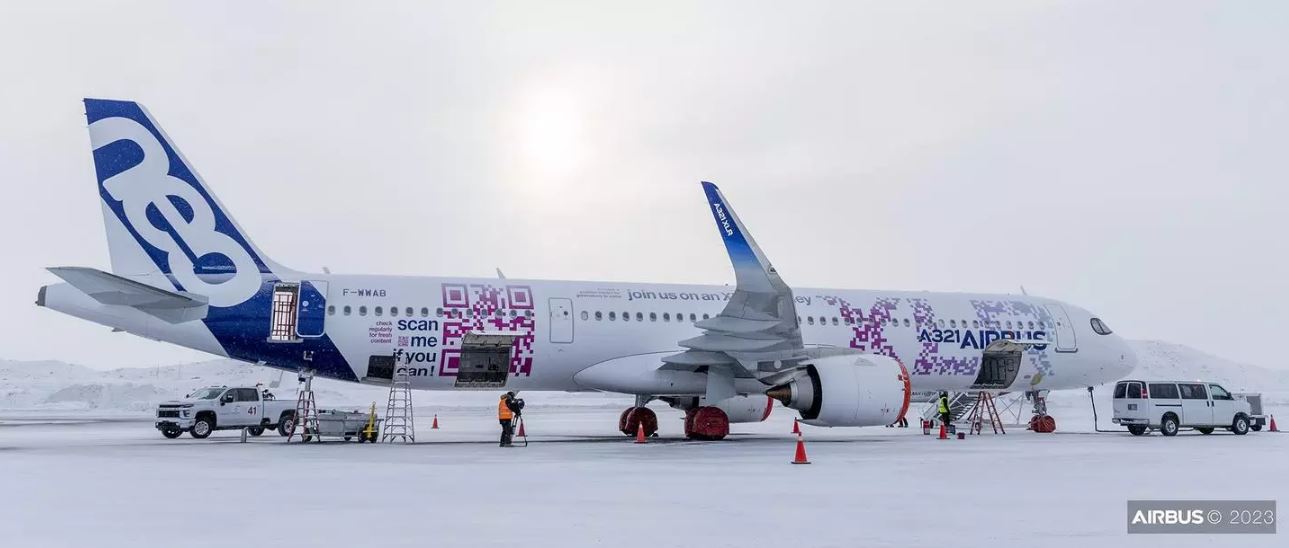
    This week the A321XLR development flight-test aircraft (“FT3”, MSN11080) dedicated to the cabin returned from its four-day cold-weather ground testing at Iqaluit in northern Canada.

    A few weeks earlier, one of the other A321XLR test aircraft (“FT2”, MSN11058) made a similar visit to Iqaluit. On that initial occasion the mission was to test the operation of the hydraulics and other systems at extreme cold temperatures – after an overnight soak at minus 40 degrees Centigrade.

    Ground testing the water and waste system

    “The objective of this most recent cold-weather campaign was to validate the aircraft operation in cold weather for ground operations,” says Tuan Do, Lead Flight Test Engineer.

    He notes: “This time around we tested the cabin water and waste system – which required the temperatures inside the unheated cabin to ‘soak’ at below -15 degrees Centigrade overnight. To this end, several cold soaks were conducted over successive nights with the doors left open, while the outside temperature was around minus 20 degrees Centigrade.

    In each case different heating and insulation configurations were applied for subsequent comparative analysis by the engineering department.”

    As part of this, a new ‘cold weather option’ available for A321XLR operators, was tested in real conditions for the first time – it adds heaters to ensure the system doesn’t freeze-up overnight. The tests also validated the ‘standard aircraft’ configuration – ie. without the optional package activated – and a weight-saving opportunity configuration, with less insulation.

    Of course, every airliner cruises at high altitudes where the outside temperatures are much lower. However, inside the cabin the water and waste systems operate in above zero temperatures. This is why ground testing (in a completely powered-down state) is specifically called for – so that the ambient environment inside the cabin and below the passenger deck, where many systems are located, can cold-soak at sub-zero temperatures.

    Hydraulics, oil and electrical system testing at -40 degrees Centigrade

    “During our first five-day visit to Iqaluit a month ago, when we powered-up the aircraft in the morning, we would ‘wake-up’ the hydraulics, electrics, and other systems and see how long it took to operate the aircraft and get it ready for taxiing and takeoff.”

    “There were also some flights to validate the landing gear operation in very cold temperatures. Notably, the A321XLR features an uprated landing gear – to support the higher maximum take-off weight of the aircraft (whose MTOW is 101 metric tonnes, vs 97 tonnes for the A321LR). Consequently, the shock-absorbers on this new variant are designed to handle higher loads compared with those on the other A320 Family members.

    The test objective was to check the ‘weight-on-wheels’ signal, so the aircraft knows when the main landing gear shock absorbers are compressed or extended.

    “There are many systems on the aircraft which depend on the weight on wheels signals to tell them whether the aircraft is in flight or on ground. So during our first visit to Iqaluit we verified how the weight-on-wheels function is affected by the physical changes in the main landing gear, and how shock absorber stiffness is affected by cold temperatures,” recalls Tuan.

    Another design feature of the -XLR related to hydraulics which needed to be evaluated in the cold environment were new hydraulic lines which pass through Rear Centre Tank, located aft of the Landing Gear bay. “Our design office colleagues wanted us to check that the routing of the pipes did not significantly affect the hydraulic temperatures and operations after warm-up of the aircraft,” notes Tuan.

    Other cold weather challenges, applicable for any aircraft, include ensuring that hatches don’t freeze shut, or that the systems in general don’t freeze up – not only the water pipes, oil and hydraulics systems, but also the electrical system, especially batteries. “Batteries don’t hold as much charge or provide as much power output when they are at low temperatures. Meanwhile, oil and hydraulics become very viscous at very low temperatures which makes it hard to move flight control surfaces around and drive pumps etc. So you need to heat the aircraft up and its pipework to be able to operate the aircraft,” explains Tuan.

    Human challenges

    The challenges behind the cold weather campaign also include human ones,” he notes. “We have maintenance and ground support teams who need to prepare and configure the aircraft, and check everything outside. They need to have the right clothes and equipment compatible with operations outside. But even with those provisions, the wind-chill factor is so strong in Iqaluit that it’s difficult. You can only work for a limited time outside, so we have shifts to ensure that nobody stays outside for too long.”

    On-site Airbus for its part, had brought a team of more than 30 people. These included: six flight crew – pilots, flight test engineers, and a test-flight engineer; a cabin specialist engineer; a maintenance team – comprising mechanical specialists, electrical specialists, quality inspectors; instrumentation specialists; systems design specialists; technical photographers; as well as an operations colleague to oversee the logistics for the overall journey.

    The human challenges are not simply on-site in Iqaluit, rather, they begin much earlier. The flight-test engineers will have agreed the test requirements with the design engineers’ office several months in advance, and from that will have prepared the campaign mission plan together with the mission flight-crew and ‘test-flight’ engineer colleagues. Together they determine how they need to configure the aircraft inside and out, when to start taxiing and then take-off, and what the ambient and systems temperature conditions should be etc. They will sequence all the testing and planning of the campaign, and of course, ensure that the whole mission is conducted safely.

  • Minister of Civil Aviation Shri Jyotiraditya M. Scindia inaugurates direct flight between Ahmedabad and Gatwick

    Minister of Civil Aviation Shri Jyotiraditya M. Scindia inaugurates direct flight between Ahmedabad and Gatwick

    • The flight will operate three days a week
    • This connectivity will boost trade and commerce and help Indian students studying in the UK

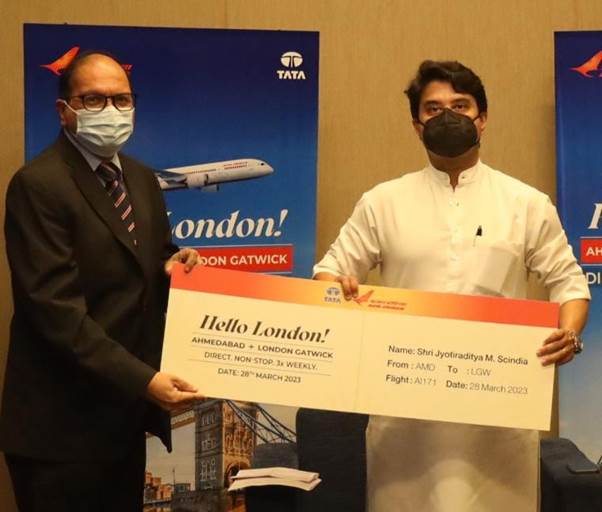
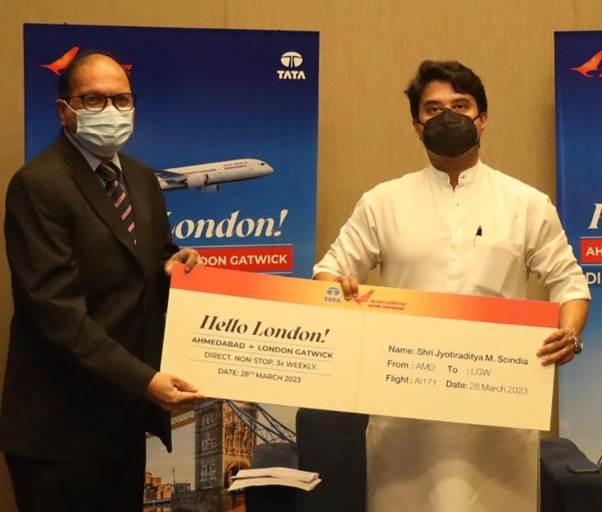
    New Delhi, 28th March, 2023. Union Minister of Civil Aviation & Steel, Shri Jyotiraditya M. Scindia inaugurated a direct flight between Ahmedabad and Gatwick today.

    The non-stop flight between Ahmedabad and Gatwick will be operated by Air India commencing from 28th March, 2023 as per the following schedule:

    Flt No. From To Freq. Dep. Time (LT) Arr. Time (LT)
    AI171 AMD LGW Thrice a week 1150 1640
    AI172 LGW AMD Thrice a week 2000 0850+1

    Image

    In his address, Shri Jyotiraditya M. Scindia said that this new air connectivity will bring in new opportunities for trade and commerce and help Indian students studying in the UK.

    Speaking on the connectivity in Ahmedabad, the minister stated that the Sardar Vallabhbhai Patel International Airport, Ahmedabad currently has the capacity to handle 50 lakh domestic and 25 lakh international passengers. The government aims to increase the passenger capacity of Ahmedabad to 1.60 crore.

    In 2013-14, Ahmedabad was connected to only 20 destinations and under the leadership of PM Narendra Modi, in the last 9 years the connectivity has increased to 57 destinations, he added. In last 9 years, the weekly air traffic movement from Ahmedabad has increased from 980 per week to 2036 per week, increase by 128%.

    On the development of civil aviation in Gujarat, Shri Scindia said that the Union Government has given specific attention to the infrastructure development in the state. A new terminal has been developed in Kandla, a new integrated terminal building in Surat with the cost of Rs 250 crore, and a new ATC Tower cum technical building in Vadodara.  Currently, Gujarat has 10 airports, and with the development of two new greenfield airports in Dholera with a cost of Rs 1305 crore and Hirasar Rajkot with a cost of Rs 1405 crore this number will increase to 12.

    In Gujarat, the number of flights operational from airports of Gujarat has increased to over 2500 from 1175 in 2013-14. Under the RCS UDAN scheme, Gujarat has been awarded 83 routes and 55 of them have already been operationalized and the rest will be operational soon.

    Shri. Balwantsinh Rajput, Minister, Government of Gujarat; Shri Rajiv Bansal, Secretary, Ministry of Civil Aviation and Shri. Campbell Wilson, CEO-Air India were also present.

  • Union Ministers Shri Anurag Thakur, Shri Jyotiraditya Scindia and Union Minister of State Gen V.K. Singh flag off first Delhi-Dharamshala-Delhi Indigo Flight

    Union Ministers Shri Anurag Thakur, Shri Jyotiraditya Scindia and Union Minister of State Gen V.K. Singh flag off first Delhi-Dharamshala-Delhi Indigo Flight

    • Indigo flight will benefit half of the State population, says Shri Anurag Thakur, requests for direct connectivity from all India
    • Target to reach 200 airports, waterdromes and heliports in next 3 to 4 years: Shri Jyotiraditya Scindia
    • 2-phase plan for expansion of Dharamshala airport underway, aim to eventually land Airbus a320: Shri Scindia

    New Delhi, 26th March, 2023. Union Minister for Information and Broadcasting Shri Anurag Thakur, Union Minister for Civil Aviation Shri Jyotiraditya Scindia and Union Minister of State for Civil Aviation General V.K. Singh on 26th March, flagged off the first Indigo Airline Delhi-Dharamshala-Delhi flight.
    Speaking on the occasion Union Minister for Information and Broadcasting Shri Anurag Thakur expressed his gratitude towards the Ministry of Civil Aviation for facilitating Indigo connectivity to Himachal Pradesh and said that Indigo could not have become a truly national airline without flying to the hill state. Shri Thakur made a case for a larger airport and said that currently passengers coming to Himachal from all over India have to go to Delhi and then board connecting flights to the State. A larger airport will provide direct seamless connectivity to passengers.

    Shri Thakur credited Prime Minister Narendra Modi for the rapid expansion of airport infrastructure in the country and said the number has gone from 74 to over 140 in a short span of time. He further said that it is due to the UDAN scheme that the people in Hawai Chappal can travel in Hawai Jahaz.

    Speaking about the magnitude of service provided by the airport, Shri Thakur said that Dharamshala airport connects five districts with ease of connectivity and directly benefits half of the population of the state. This single Indigo flight goes a long way in connecting half of the state and a few places in Punjab to the rest of the country.

    Union Minister of State General V. K. Singh in his remarks stated that the Dharamshala airport had seen its first flight in 1990, subsequently saw its operations expanding and now has a runway of 1376 mts. The Minister said the runway can be further lengthened if space permits. The airport witnesses a lot of traffic due to the presence of Dalai Lama, he stated, and provides air connectivity to all of north-western Himachal Pradesh The Indigo flight will bring in more tourists to Himachal and this will benefit the people of the state.

    Union Minister for Civil Aviation Shri Jyotiraditya Scindia, addressing the gathering, said that what was not achieved in the past 65 years in the field of civil aviation has been achieved in the last 9 years with the creation of 148 airports, waterdrome and heliports. He further added that the Ministry is working towards a target of taking this number to beyond 200 within the next three to four years. This effort will give equal importance to large metro airports as well as remote airports providing last mile connectivity.

    Shri Scindia lauded Shri Anurag Thakur’s efforts towards creation of sports infrastructure in the State and said that it is because of his strenuous efforts, Dharamshala is today a hub of not just regional or national cricket but of international cricket. He drew parallels between the magnificent stadium in Dharamshala to the best in the world. Cricket, he further added, has brought the State a surge in economic activity, and the credit for this too goes to Shri Anurag Thakur.

    The Minister acknowledged the request of expansion of Dharamshala airport by Shri Anurag Thakur and said that his Ministry is already working on a 2-phase plan for the same. The first phase involves lengthening of the current runway to 1900 mts to enable turboprop aircrafts landing with load penalty to ply without such penalties. The 2nd phase would involve further lengthening of the runway to 3110 mts to realize the vision of landing Boeing 737 and Airbus a320 at the airport.

    Speaking about the other achievements in the State for his Ministry, Shri Scindia said that runway restoration at the Shimla airport has been completed and site clearance has been provided for a Greenfield airport at Mandi. The Minister reiterated that his Ministry is committed towards the development of civil aviation infrastructure in the State.

    “Civil aviation sector has seen a complete democratization, and those who could only watch aircrafts fly are today flying in it”, remarked the Minister and further stated that the vision of Prime Minister Shri Narendra Modi in the form UDAN Scheme has seen 1 crore 15 lakh such people added to number India’s air passengers.

    The State of Himachal has been provided 44 routes under UDAN, of which 22 are already operational. Highlighting the Ministry’s achievements in the State, the Minister said that the connectivity has increased from 40 aircrafts per week in 2013-14 to 110 aircrafts, an increase of 175% over 9 years. In Dharamshala specifically, he said, the number of air traffic movements have gone up by 110% in the past 9 years from 28 per week in 2013-14 to 50 movements today.

    Shri Kishan Kapoor, Member of Parliament from Kangra, Himachal Pradesh, said that the aircraft is a major contribution to air connectivity for the people of the State. The State had seen a tremendous decline in tourist activity during COVID19 pandemic and is now witnessing a revival. Shri Kapoor requested the Ministry of Civil Aviation to consider further expanding the number of aircrafts flying to Dharamshala.

    Indigo airline will operate daily flights to Dharamshala from Delhi. This new flight sector takes the number of daily flights of Indigo to 1795 and makes it the seventh largest airline in the world in terms of departures.

  • Airbus Final Assembly Line in China delivers its first A321neo

    Airbus Final Assembly Line in China delivers its first A321neo

    • An A321neo aircraft to China’s Juneyao Air
    • Flight operated with Sustainable Aviation Fuel

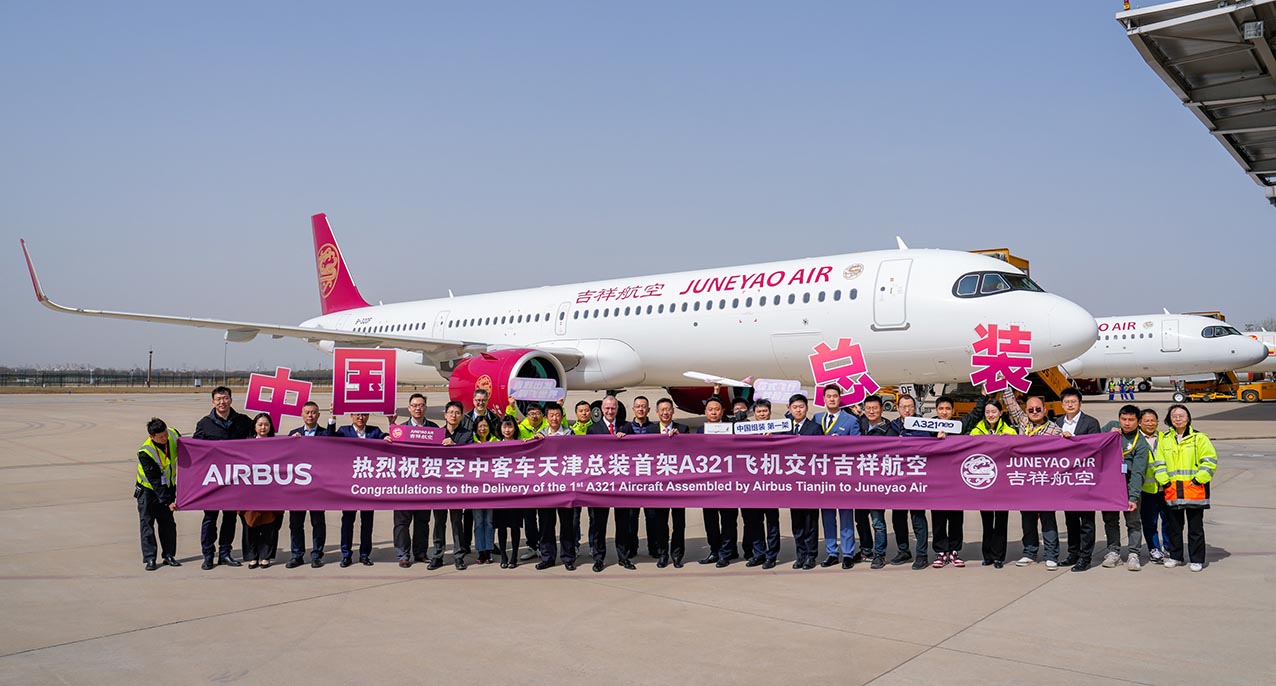
    Tianjin, 24th March 2023. Airbus has delivered the first A321neo aircraft assembled at its Final Assembly Line Asia (FAL Tianjin) to China’s Juneyao Air in Tianjin, China. The aircraft is powered by Pratt & Whitney GTF engines and features 207 comfortable seats, 8 in Business and 199 in Economy class. Its delivery flight is to use a ten percent Sustainable Aviation Fuel blend in support of the green aviation strategy in China.  

    “Since we announced the commissioning of the first A321 aircraft at FAL Tianjin last November, the relevant final assembly activities and tests went on smoothly, showcasing the maturity of FAL Tianjin to quickly adapt to new products,” said George Xu, Airbus Executive Vice President and Airbus China CEO. “The successful delivery of the first A321 aircraft enables Airbus to honour the popularity of the aircraft for the China market and beyond – and the consistent trust and support from our customers. Airbus continues to expand and enhance its comprehensive cooperation with China’s aviation industry, underlining its long-term commitment to China to ensure customer proximity while supporting the global commercial aircraft production ramp-up.”

    Airbus has four A320 Family final assembly facilities around the world: Hamburg, Germany; Toulouse, France; Tianjin, China; and Mobile, United States. With the conversion of the Tianjin facility last year, and with the newest facility about to complete its transformation in Toulouse, the global industrial system will be fully A321-capable, creating flexibility and agility to meet Airbus’ ramp up objectives and the rising market success of the A321 model.

    Inaugurated in 2008, the FAL in Tianjin was the first Airbus commercial aircraft assembly line outside Europe. In the same year, the first aircraft sections arrived on site. Since its first A320 delivery in 2009, Airbus’ FAL in Tianjin has delivered more than 600 aircraft over its 14 years in operation. The A321neo is the longest-fuselage member of Airbus’ best-selling, single-aisle A320 Family, comfortably seating as many as 244 passengers, with a longest range reaching 4,700nm/8,700km. Featuring the widest single-aisle cabin in the sky, the A320neo Family offers at least  20 percent reduction in fuel consumption and CO2 as well as a 50 percent noise reduction compared to previous generation aircraft, thanks to incorporating the very latest technologies including new generation engines and Sharklets. By the end of January 2023, the A320neo Family had received over 8,600 firm orders from more than 130 customers worldwide.

  • Japan Airlines Selects 737-8 to Grow Sustainable World-Class Fleet

    Japan Airlines Selects 737-8 to Grow Sustainable World-Class Fleet

    • Japan Airlines announces firm order for 21 fuel-efficient 737-8 jets to support fleet renewal
    • Optimizing JAL single-aisle operations while reducing fuel use and carbon emissions
    Boeing and Japan Airlines (JAL) have finalized an order for 21 super-efficient 737-8 jets.

    SEATTLE, 23rd March. Boeing and Japan Airlines (JAL) have finalized an order for 21 super-efficient 737-8 jets.

    The versatile 737-8 will position JAL to strengthen its domestic and regional network as passenger traffic continues to return to pre-pandemic levels. JAL intends to begin introducing the airplanes into its fleet from 2026.

    “We are delighted to select the Boeing 737-8, a member of the very latest 737 MAX family, to replace our Boeing 737-800s, which make up the largest proportion of the JAL Group’s fleet,” said Yuji Akasaka, president of Japan Airlines. “We look forward to carrying our passengers in the utmost safety and comfort and to moving closer to our 2050 carbon-neutral goals, thanks to a combination of these super-efficient aircraft, operational innovations and new fuel-saving technologies.”

    The 737 MAX will provide JAL with greater range and fuel efficiency, reducing both fuel use and carbon emissions by 15% compared to the airplanes the airline is replacing. In addition, the 737 MAX is a quieter airplane, creating a significantly smaller noise footprint than the airplanes it replaces.

    “The integration of the new 737 MAX will provide JAL with greater efficiency across its short-haul network, as the airline continues to upgrade its world-class fleet,” said Stan Deal, president and CEO of Boeing Commercial Airplanes. “Partnering with JAL to introduce 737-8s into its operations is the latest milestone in our longstanding relationship.”

    The 737 MAX family has the latest CFM International LEAP-1B engines, advanced technology winglets and other aerodynamic enhancements to improve performance. More than 50 airlines globally are operating over 900 737 MAX airplanes, which have made over 1.4 million revenue flights totaling more than 3.5 million flight hours since late 2020.

  • Norwegian Air Ambulance expands its H145 fleet

    Norwegian Air Ambulance expands its H145 fleet

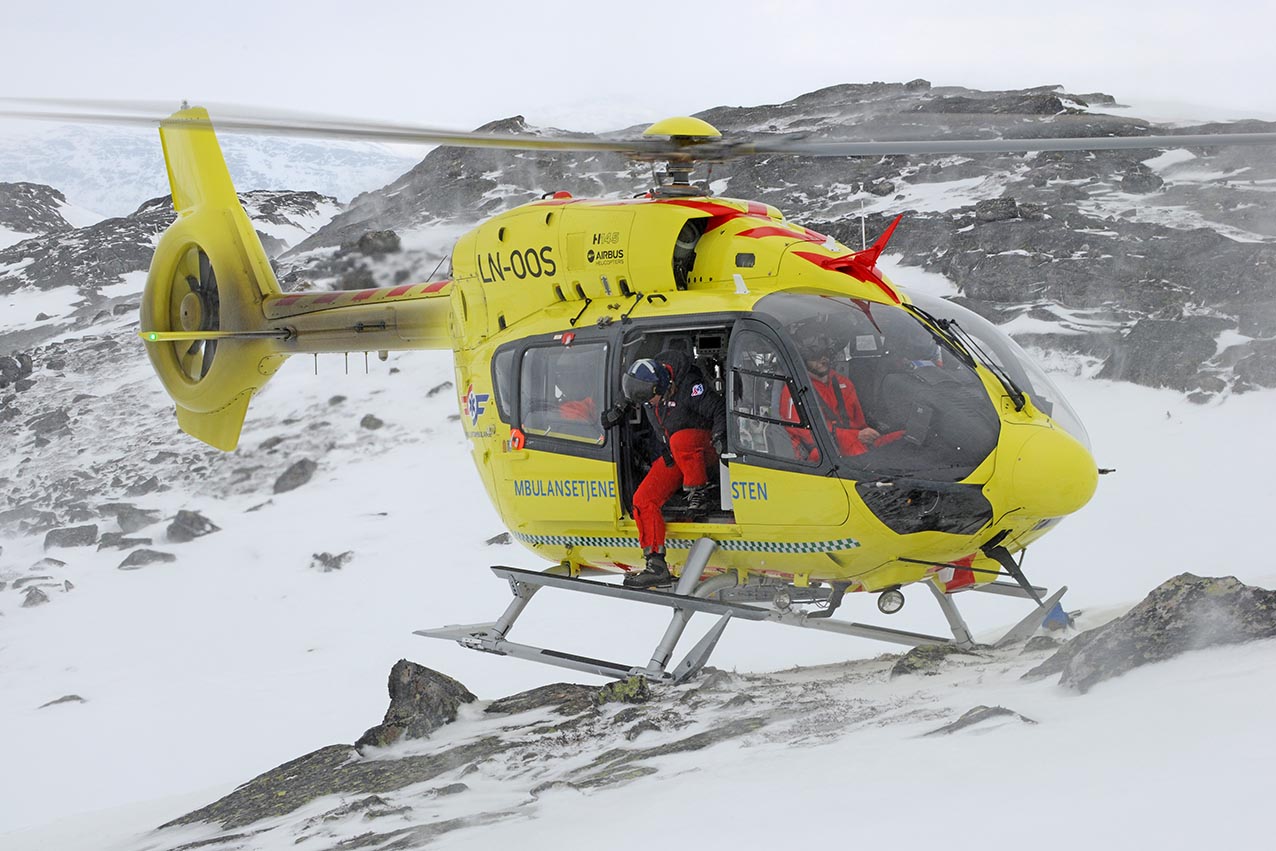
    Donauwörth, 14th March. The Norwegian Air Ambulance is ordering two five-bladed H145s to be used for life-saving missions in Norway.

    “I would like to thank the Norwegian Air Ambulance for its continued trust in our helicopters to support their essential, life-saving missions,” said Thomas Hein, Head of Europe Region at Airbus Helicopters. “We’re proud that they are further expanding their fleet of five-bladed H145s.”

    “The five-bladed H145 has proven to be the perfect helicopter for our HEMS operations,” said Leif Olstad, CEO of the Norwegian Air Ambulance. “With the new helicopters we will continue to serve the people of Norway with state of the art equipment to ensure the best service possible.”

    Today, Norwegian Air Ambulance operates all 13 HEMS bases in Norway using a 100% Helionix-equipped fleet of H135s and H145s. The organisation’s mother company, the Norwegian Air Ambulance Foundation, was the first operator in the world to take delivery of a five-bladed H145 in 2020.

    The new version of Airbus’ best-selling H145 light twin-engine helicopter adds a new, innovative five-bladed rotor to the multi-mission aircraft, increasing the useful load of the helicopter by 150kg (330 lbs.). The simplicity of the new bearingless main rotor design also eases maintenance operations, further improving the benchmark serviceability and reliability of the H145, while improving ride comfort for both passengers and crew.

    In total, there are more than 1,600 H145 family helicopters in service, logging a total of more than seven million flight hours. Powered by two Safran Arriel 2E engines, the H145 is equipped with full authority digital engine control (FADEC) and the Helionix digital avionics suite. It includes a high performance 4-axis autopilot, increasing safety and reducing pilot workload. Its particularly low acoustic footprint makes the H145 the quietest helicopter in its class, while its CO2 emissions are the lowest amongst its competitors.

    Airbus Helicopters is the leading provider of helicopters to the air medical transport industry, providing some 54% of the 2,700 EMS helicopters flying in the world today.

  • Boeing Forecasts Resiliency and Increased Growth for Aircraft Finance

    Boeing Forecasts Resiliency and Increased Growth for Aircraft Finance

    • 2023 commercial aircraft financing to reach near pre-pandemic levels
    • 100% of commercial deliveries funded by third parties for the past three years
    Boeing Reports Resiliency and Increased Growth for Aircraft Finance, 2023 Commercial Aircraft Finance Market Outlook shows another year of recovery and increased demand from aircraft financiers and investors. (Boeing image)

    SEATTLE. Boeing on 15th March released the 2023 Commercial Aircraft Finance Market Outlook (CAFMO) showing another year of recovery and increased demand from aircraft financiers and investors.

    “With production and delivery increases and the reopening of certain regional markets, we forecast aircraft financing needs to reach near pre-pandemic levels in 2023,” said Rich Hammond, vice president of Customer Finance at Boeing. “This positive trend reaffirms that our industry’s fundamentals are strong and aircraft financiers and investors are well positioned as travel continues to recover.”

    The 2023 CAFMO is Boeing’s annual review of aircraft financing trends and assesses near-term market dynamics and financing sources for new commercial airplane deliveries.

    An introductory video, presentation and regional financing data is available at www.boeing.com/CAFMO. Select highlights include:

    • In 2022, the majority of Boeing airplanes were funded with cash due to strong operational performance and de-leveraging efforts by customers.
    • While cash funding will continue to play a significant part in delivery financing, the use of capital markets, bank debt and export credit is expected to expand.
    • 2022 capital markets activity was lower compared to its heightened activity recorded in 2021.
    • Export credit agencies supported nearly 5% of Boeing deliveries in 2022.
    • Lessor-supported deliveries will remain stable but may face competition from other financing sources.

    The Boeing 2022 Commercial Market Outlook, a separate annual 20-year forecast addressing the market for commercial airplanes and services, reflects that the global market is recovering as Boeing projected in 2020. Demand for domestic air travel has made a strong recovery across a number of regions, with international traffic gaining momentum as restrictions ease, tracking to return to pre-pandemic levels by 2023 to 2024.

    Caution Concerning Forward-looking Statements

    Certain statements in this presentation may be “forward-looking” within the meaning of the Private Securities Litigation Reform Act of 1995. Words such as “may,” “should,” “expects,” “intends,” “projects,” “plans,” “believes,” “estimates,” “targets,” “anticipates” and similar expressions generally identify these forward-looking statements. Examples of forward-looking statements include statements relating to our future plans, business prospects, financial condition and operating results, as well as any other statement that does not directly relate to any historical or current fact. Forward-looking statements are based on expectations and assumptions that we believe to be reasonable when made, but that may not prove to be accurate. These statements are not guarantees and are subject to risks, uncertainties and changes in circumstances that are difficult to predict. Many factors could cause actual results to differ materially and adversely from these forward-looking statements, including the COVID-19 pandemic and related industry impacts; the timing and conditions of 737 MAX or other airplane model regulatory approvals, lower-than-planned production rates and/or delivery rates, and increased considerations to customers and suppliers; economic and geopolitical conditions in the United States and globally; general market and industry conditions as they may impact us or our customers; reliance on our commercial customers, our U.S. government customers and our suppliers; the overall health of our aircraft production system, as well as the other important factors disclosed previously and from time to time in The Boeing Company’s filings with the Securities and Exchange Commission. Any forward-looking statement speaks only as of the date on which it is made, and we assume no obligation to update or revise any such statement, whether as a result of new information, future events or otherwise, except as required by law.